Hello, world leaders.
The next update is one of the biggest changes to how the world of Global Protocol works since launch. It rebuilds three things at once: how the world trades, who leads it, and what it costs to end a war.
Trade gets a real network of ports, sea lanes and straits, so trade between countries now travels a route and pays freight on the way. That route can be closed by a crisis. Great powers can build spheres of influence, but only with the consent of the countries they lead. And peace is no longer a single button: you pick the provinces you want on the map, and the other side tells you whether it will sign.
One honest note before we start: this is a preview. Every screenshot below comes from the current development build, taken from games we played forward a few months as the United States, Germany, Australia and Turkey. Numbers and details can still change before the update ships.
Why we rebuilt trade
In the current version, trade works, but it floats above the map. You can sign trade agreements with other countries — tariffs, export terms and priority resources — but they run forever and can’t be negotiated. Spot purchases and your private sector’s everyday imports and exports all go through one abstract world market, with no partner country behind them. Nothing travels: there are no ports, no sea lanes and no freight, and the Economy map only draws lines from a capital to its trade partners’ capitals. And trade is spread across the Economy page, the Markets workspace, a trade ticket, a trade log and the diplomatic inbox.
So we rebuilt it around one idea: trade should happen between real places, along real routes.
- Real partners. Your private sector’s imports and exports are now matched with actual partner countries first, and exported goods really leave the seller’s stockpile. Only what partners can’t supply or buy still goes to the world market, shown as “the rest of the world”.
- Real routes. Trade between countries travels along lanes that follow real sea routes and land corridors, through real chokepoints, and pays freight by distance.
- Real negotiation. Deals have a length, a fixed or market-linked price, counter-offers and renewals.
- Real consequences. When a strait closes, a war starts or sanctions hit, the trade that depended on them has to find another way, or stop.
Trade hubs: where the world’s goods pass
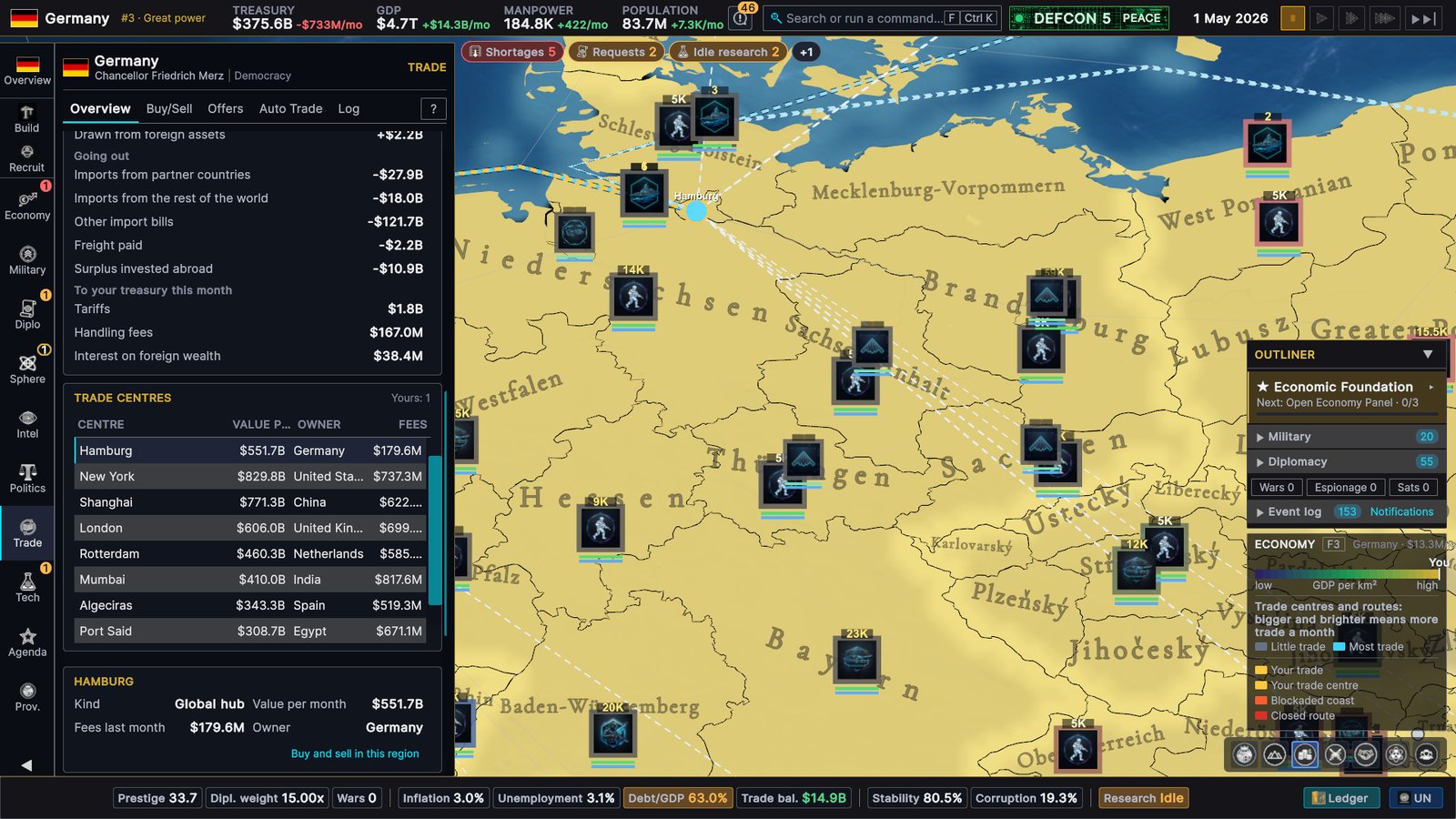
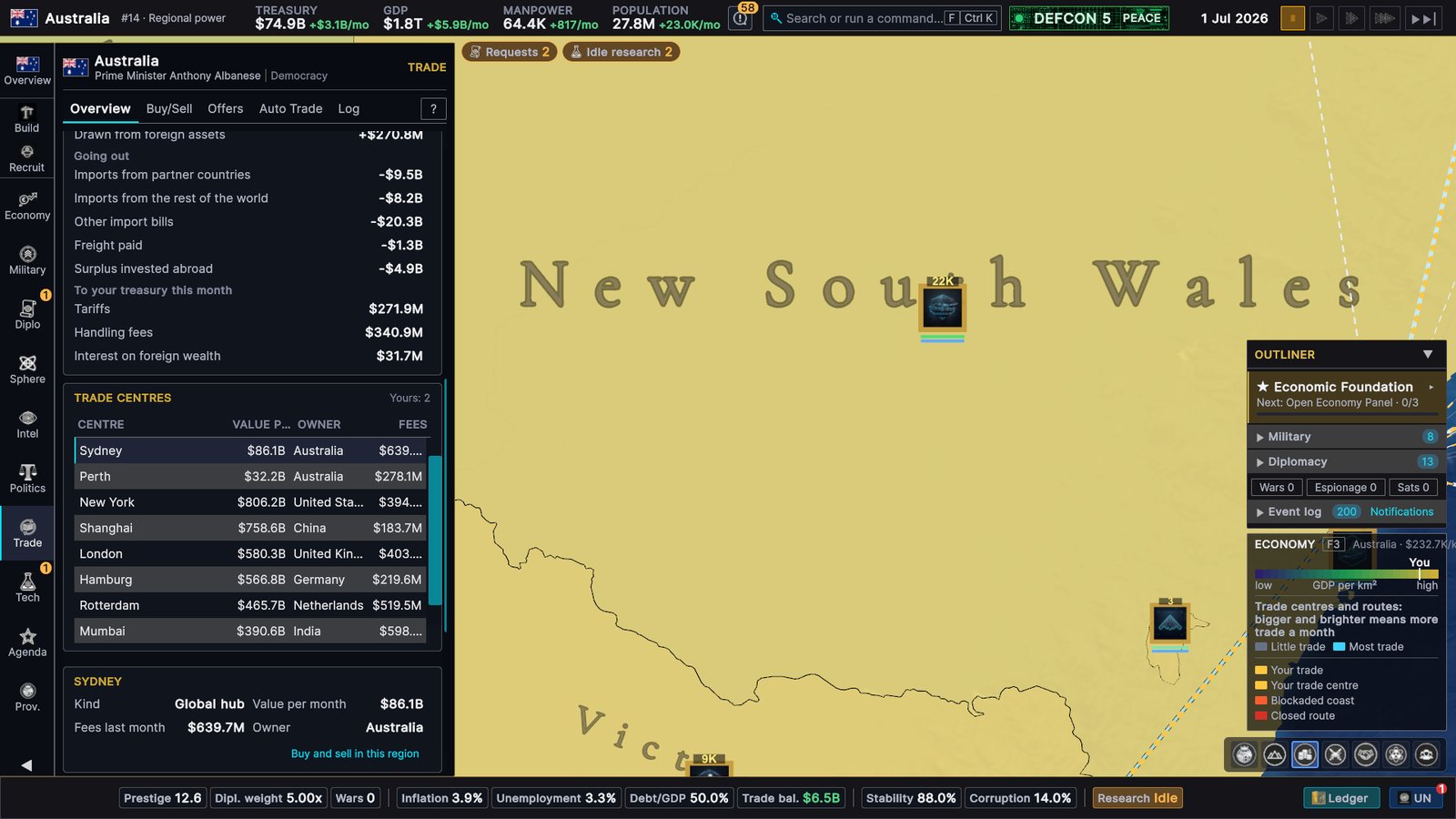
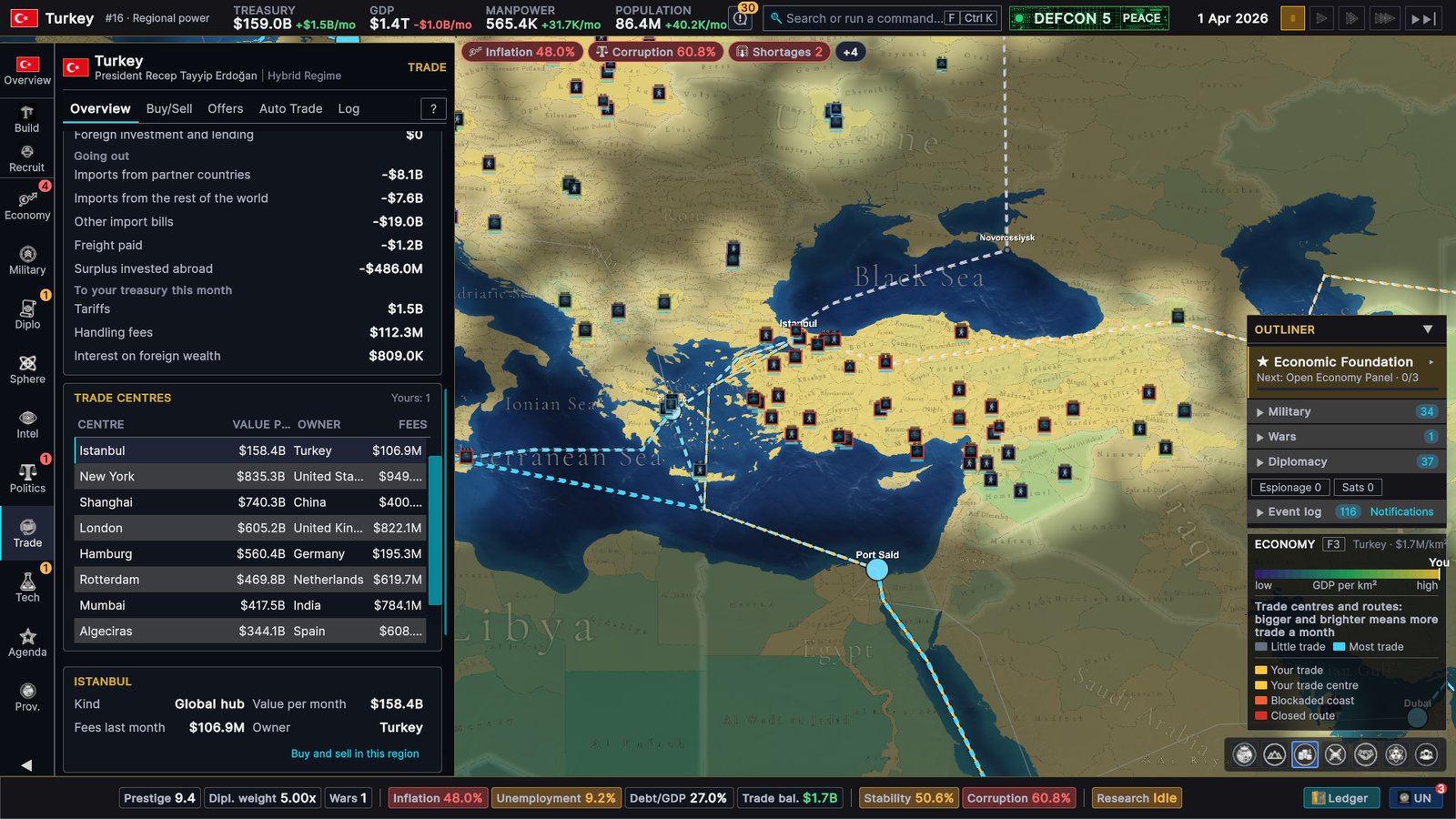
The network is built on 236 trade centres in three tiers: 26 global hubs such as New York, Rotterdam, Hamburg, Istanbul, Port Said, Singapore and Shanghai; 30 regional centres; and a national centre for every playable country. Each sits on a real port or city province on the map, linked by 145 lanes.
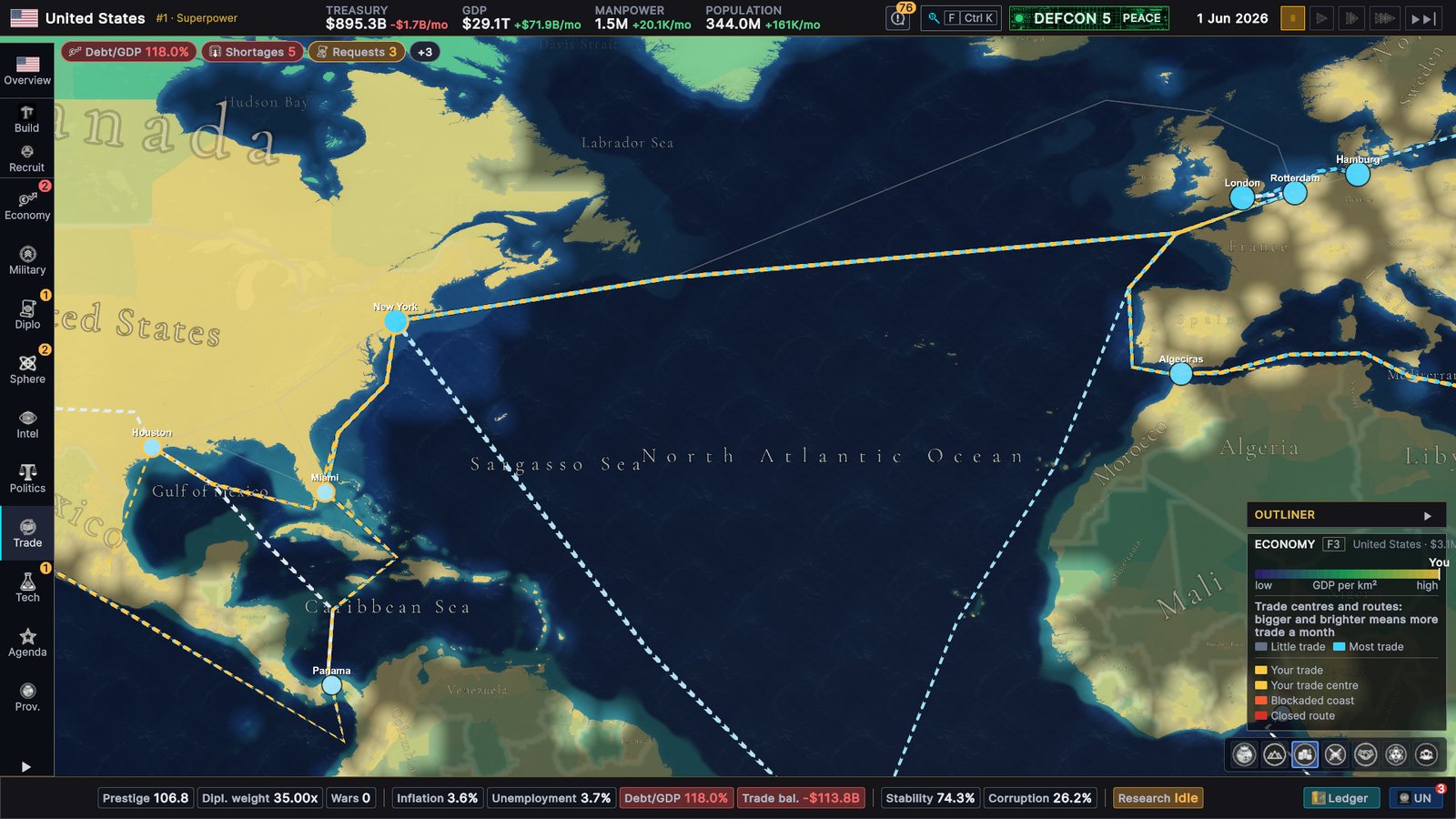
Switch to the Economy map mode, or open the new Trade page, and the network appears on the map:
- Bigger and brighter means busier. A centre’s size and glow come from the value of the trade that actually passes through it each month.
- Your trade is drawn in gold, on top of everyone else’s, with animated chevrons running from seller to buyer.
- Routes switch between sea and land where a land corridor is the better way, at a handling cost.
Click any centre and its card opens on the Trade page: what kind of centre it is, how much value passes through it each month, who owns it and what it earned in handling fees.
Hubs pay their owners
A trade centre is now worth owning — and worth fighting over.
- A commerce edge. Each centre you own adds to your economy’s commerce, more the busier it is: up to 4% per centre and 8% in total. An idle hub is worth little; a busy regional port is worth a lot.
- Handling fees. 8% of the freight on every route is shared among the centres it passes through, bigger centres taking a bigger share. The fees come out of the freight the importer already pays, and each owner’s monthly take is capped relative to its economy.
- Conquest moves them. Take the province, and its centre — with its bonus and its fees — changes hands.
A deal, from offer to delivery
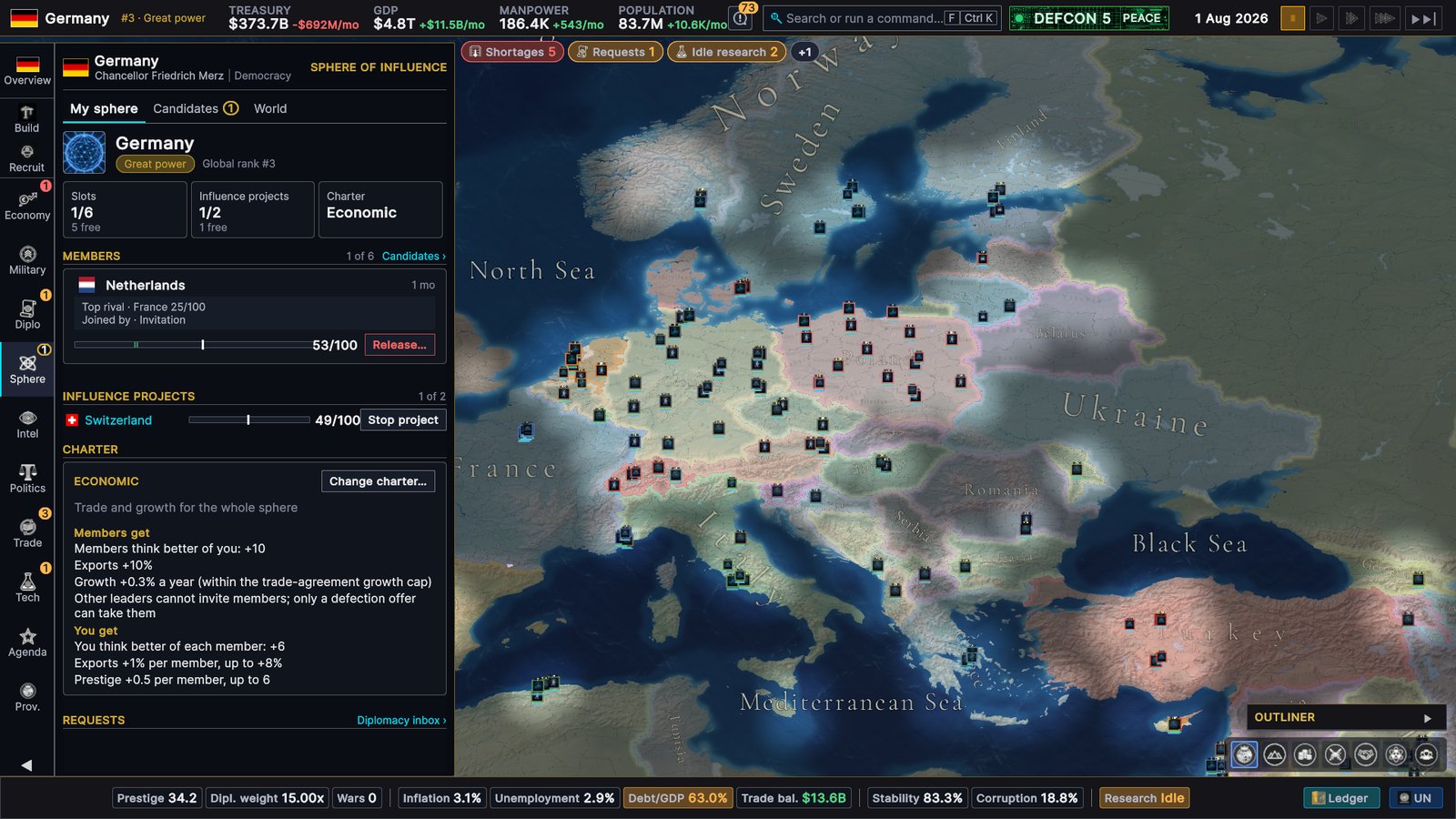
The new Trade page has its own place in the sidebar, with five tabs: Overview, Buy/Sell, Offers, Auto Trade and Log. Here is one deal, start to finish.
1. The offer arrives. Other countries now send you supply contracts — at most one per country a month, and only when relations are good enough. Each one arrives as a toast and in your Diplomatic Inbox, and both take you straight to its card.
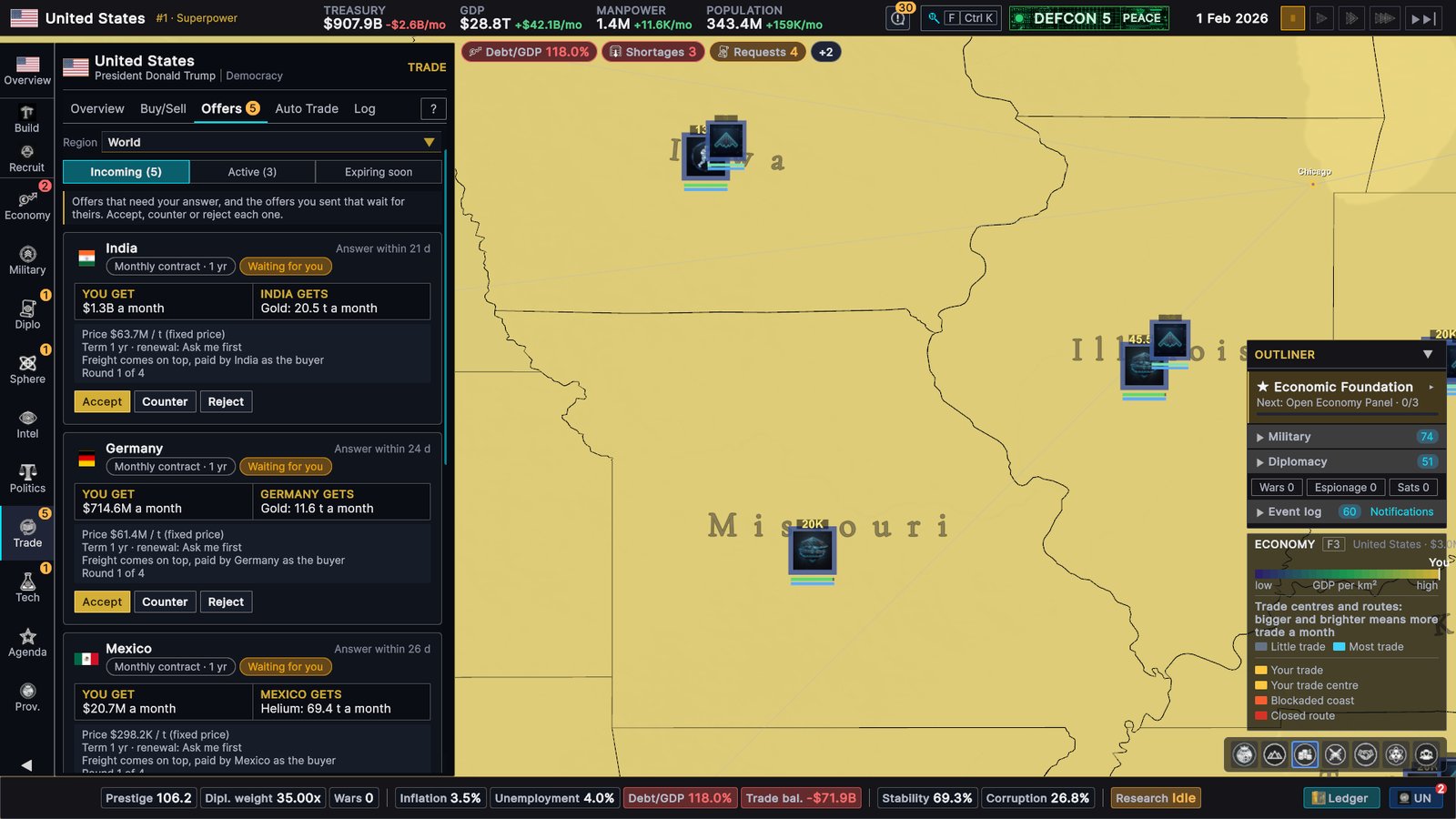
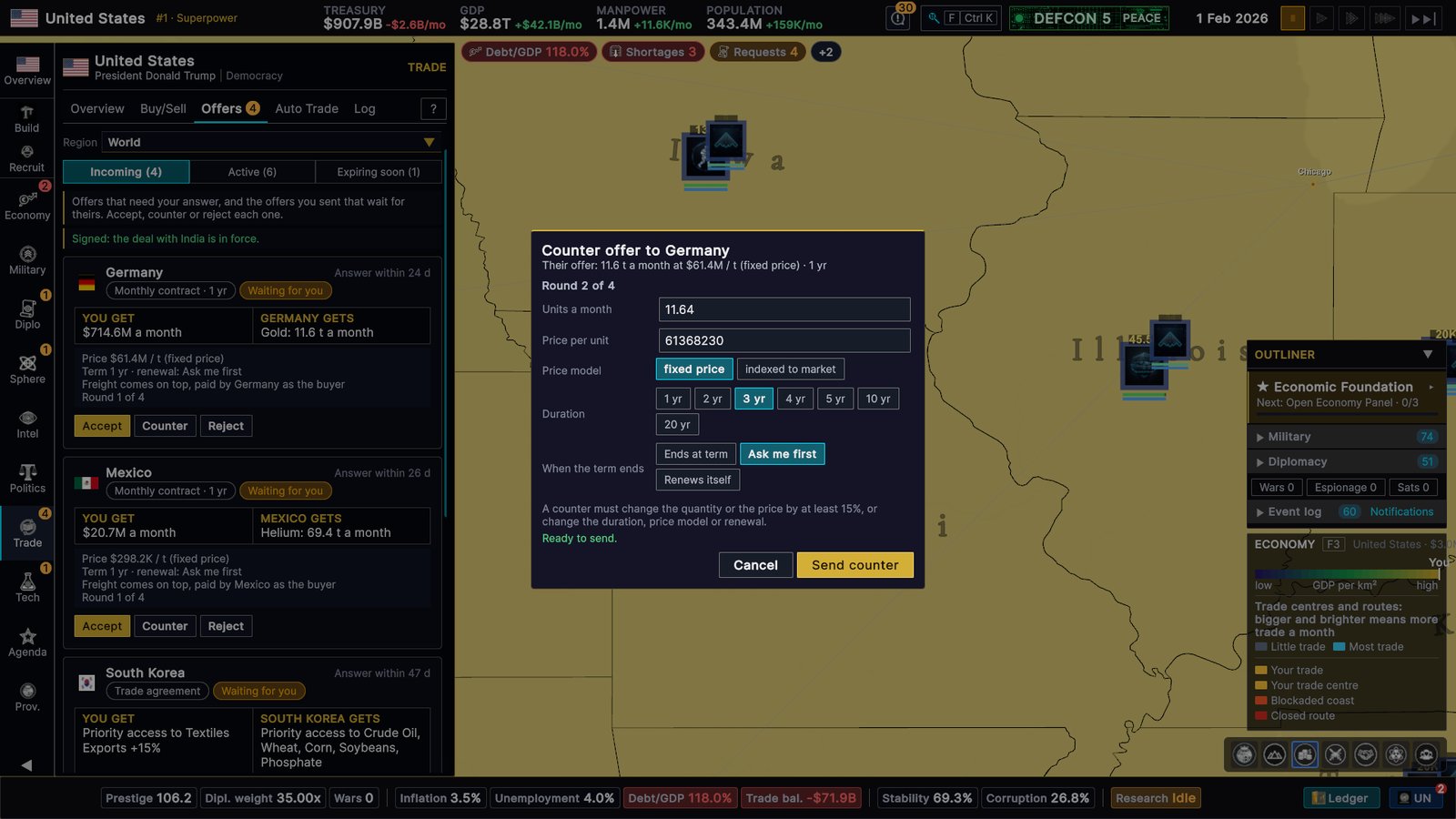
2. You negotiate. Accept, reject — or counter. A counter can change the quantity, the price, the length of the deal (1 to 20 years), whether the price is fixed or follows the world market, and what happens when the term ends. You have up to four rounds, and a counter has to actually change something: at least 15% on quantity or price, or a different term.
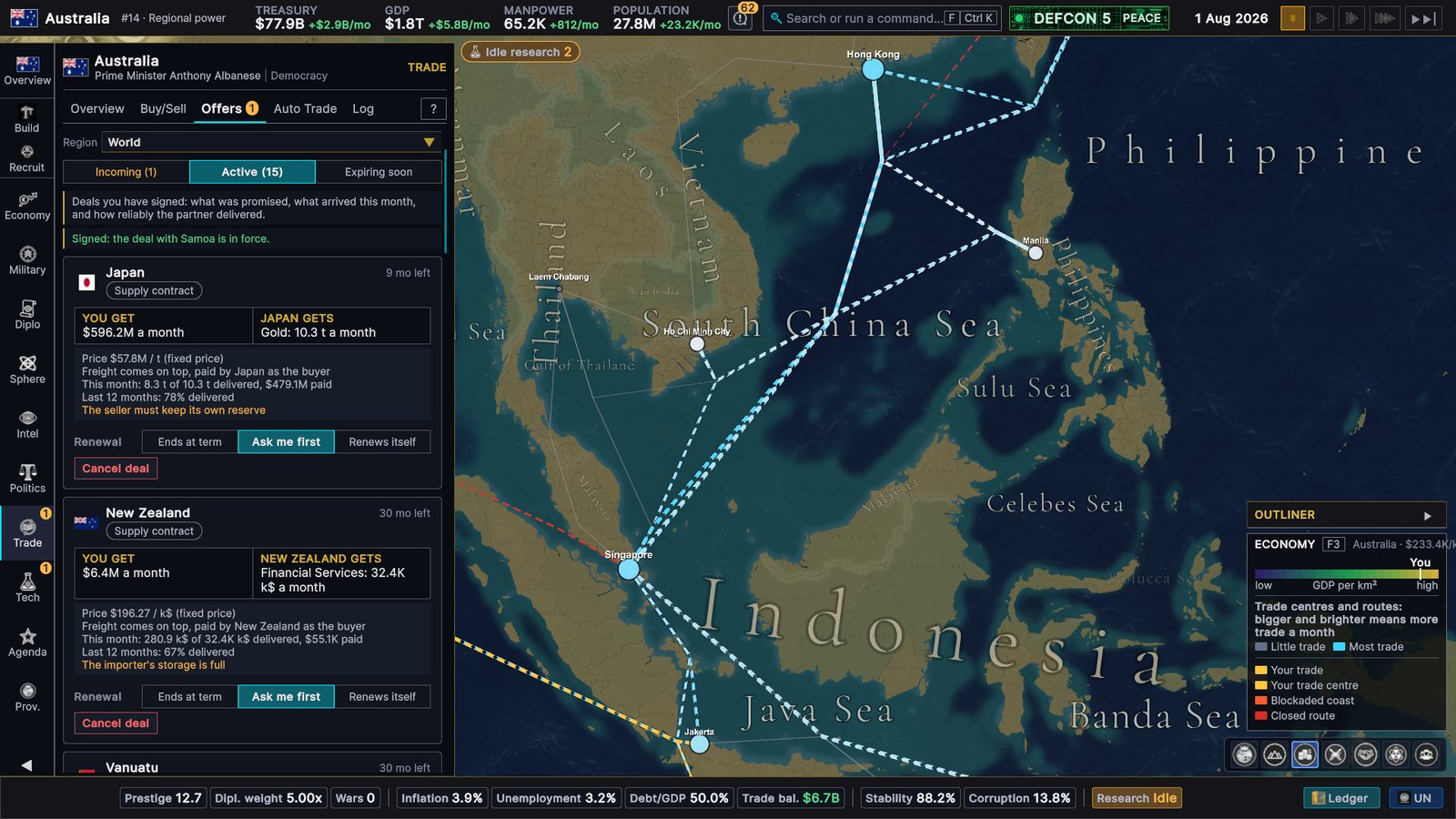
3. The deal runs. Signed deals live under Active. Every month you see what was promised, what actually arrived, what you paid, and how reliably the partner has delivered over the last year — and when a delivery falls short, the card says why. Set a deal to Ask me first, and three months before it ends you’re asked whether to renew it.
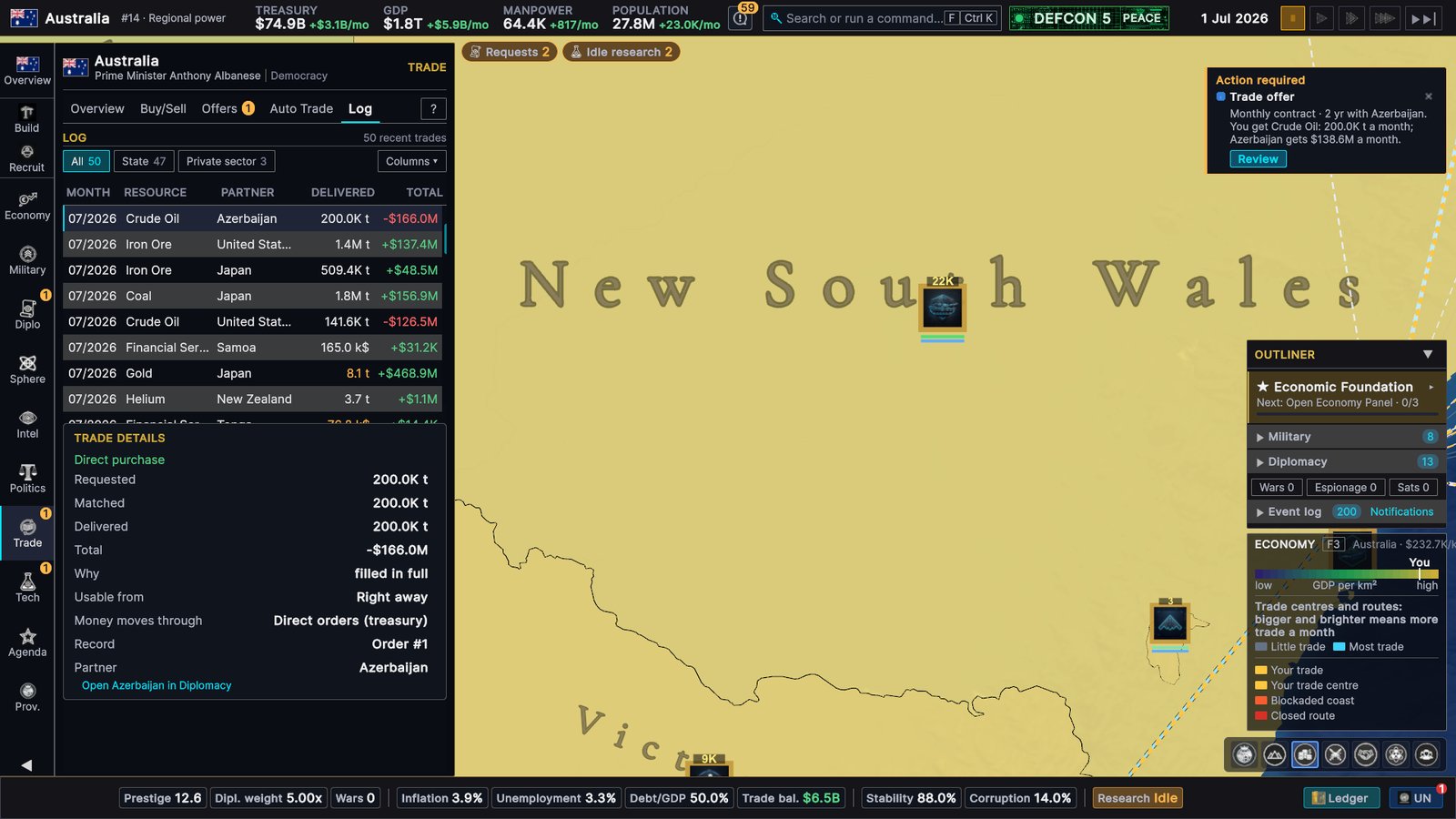
4. Every delivery is logged. The Log lists every trade of the month — the state’s contracts and orders, and your private sector’s trade — with the partner, the amount and the money. Select a row to see what was asked for, what was matched, what was delivered, why, and when the goods can be used.
Two more ways to trade complete the page. Buy/Sell finds every country with spare stock of a resource and ranks them by delivered cost — the price plus the freight to your ports — before you place a one-off order or propose a monthly deal; or you can still buy and sell on the world market. Auto Trade sets the prices and amounts your country may buy and sell automatically, so reserves top themselves up within the limits you choose.
Your foreign account
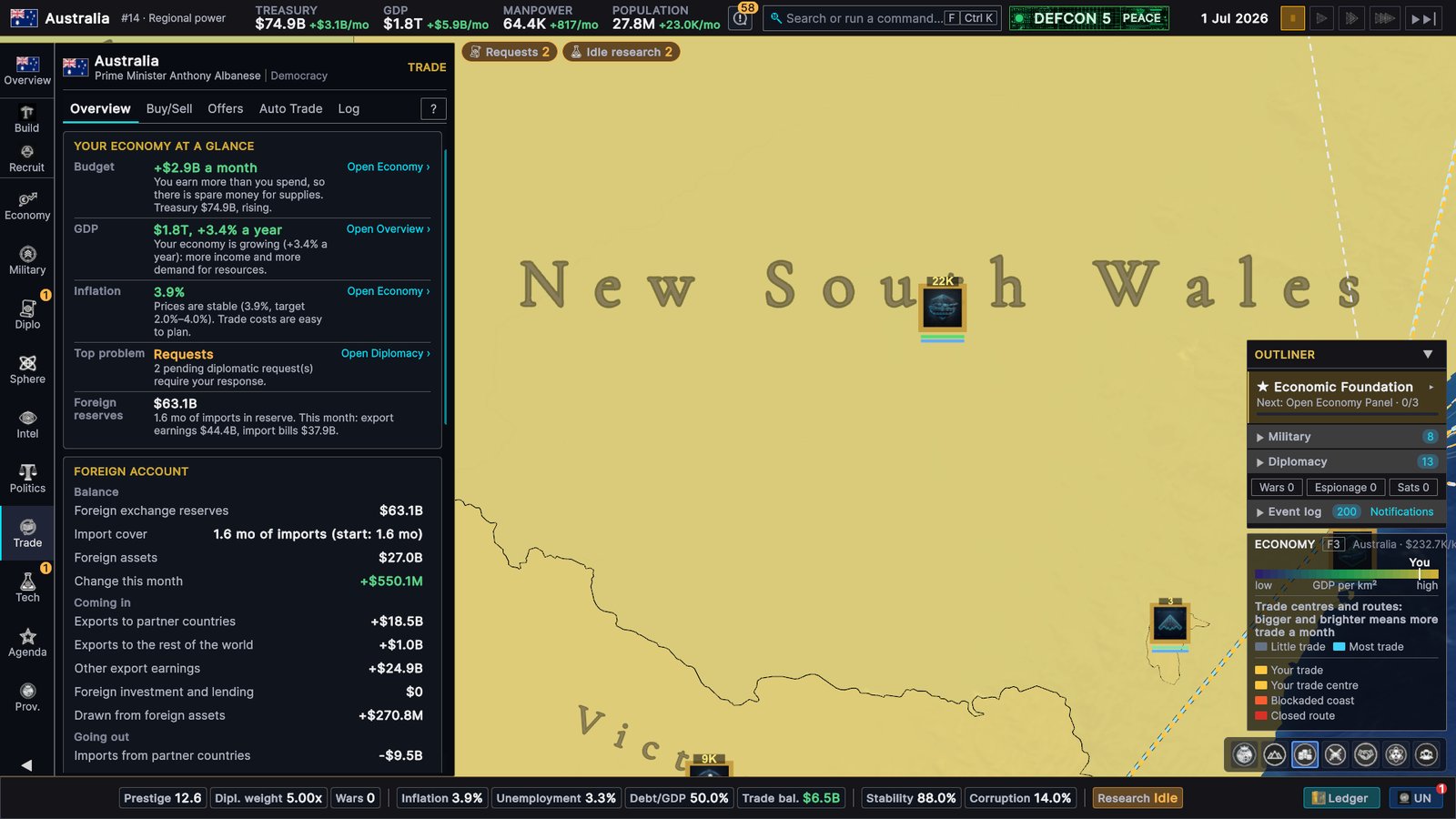
Private trade has always kept its money off your treasury: export earnings went into your country’s foreign exchange reserves. But until now nothing used those reserves and no screen showed them, so a trade deficit cost you nothing you could see. In this update that account becomes real and visible: the foreign account, made of your foreign exchange reserves and foreign assets, and it now pays your private sector’s import bills.
- Overview tells you where you stand: your reserves, how many months of imports they cover, and what came in and went out this month.
- Running short has a cost. When the account can’t pay the whole import bill, imports shrink.
- Low import cover becomes a warning in your attention list, before it becomes a crisis.
- Your treasury still benefits. Tariffs, handling fees and interest on your foreign wealth flow into the budget, each as its own row.
When trade gets blocked
This is where the network earns its keep. Fourteen chokepoints sit on the lanes, and four crises in the game can close one:
| Crisis | Closes | For |
|---|---|---|
| Suez Canal blockage | the Suez Canal | 2 months |
| South China Sea crisis | the Malacca and Taiwan straits | 3 months |
| Strait of Hormuz crisis | the Strait of Hormuz, if that option is chosen | 6 months |
| Taiwan Strait crisis | the Taiwan Strait, if it turns into a blockade | 6 months |
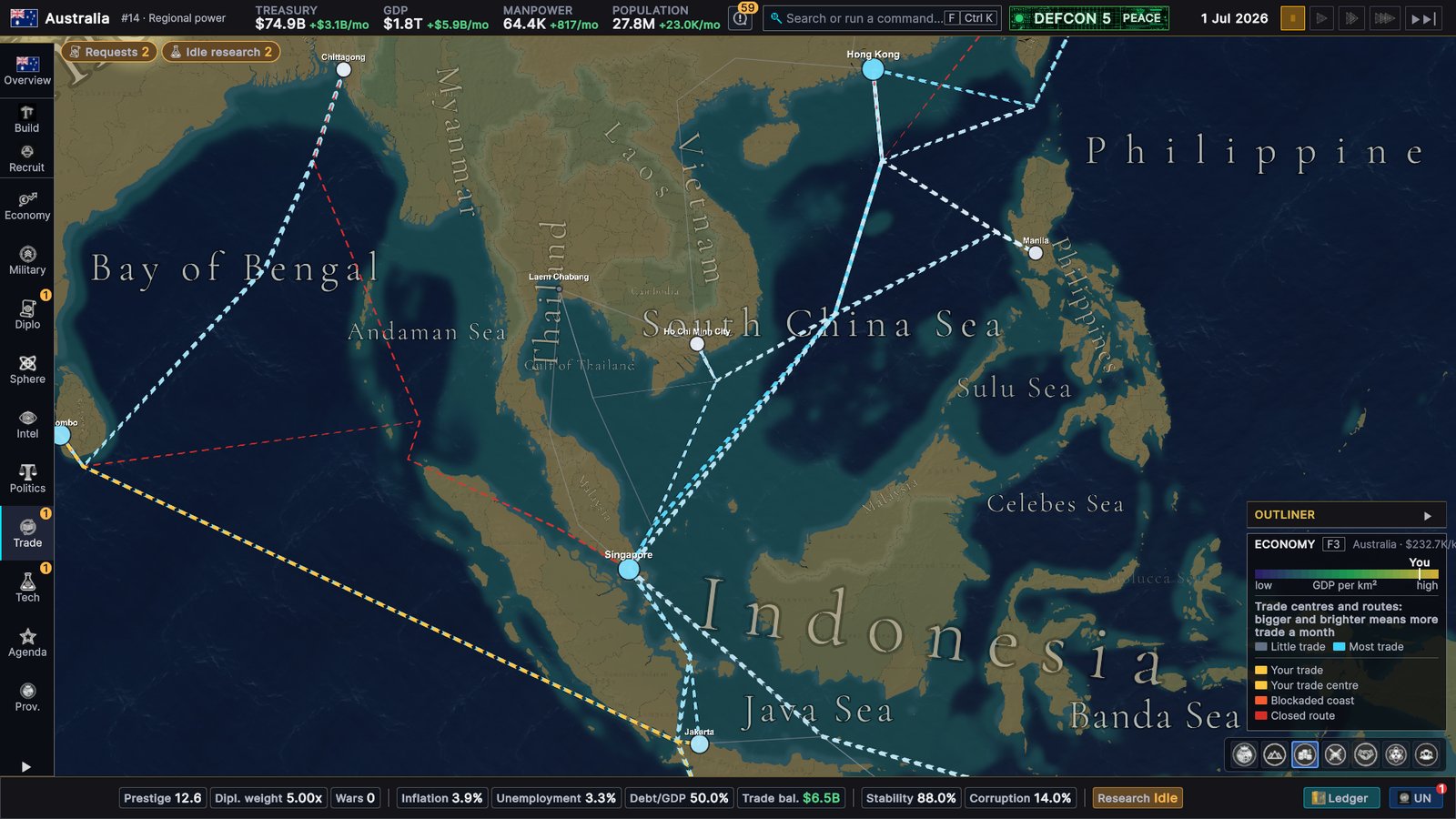
A closed route turns red on the map and carries nothing. Trade that used it looks for the next way round — longer, with more freight to pay — and the centres along the old route lose business.
Here is the Suez Canal closing, seen from Germany.
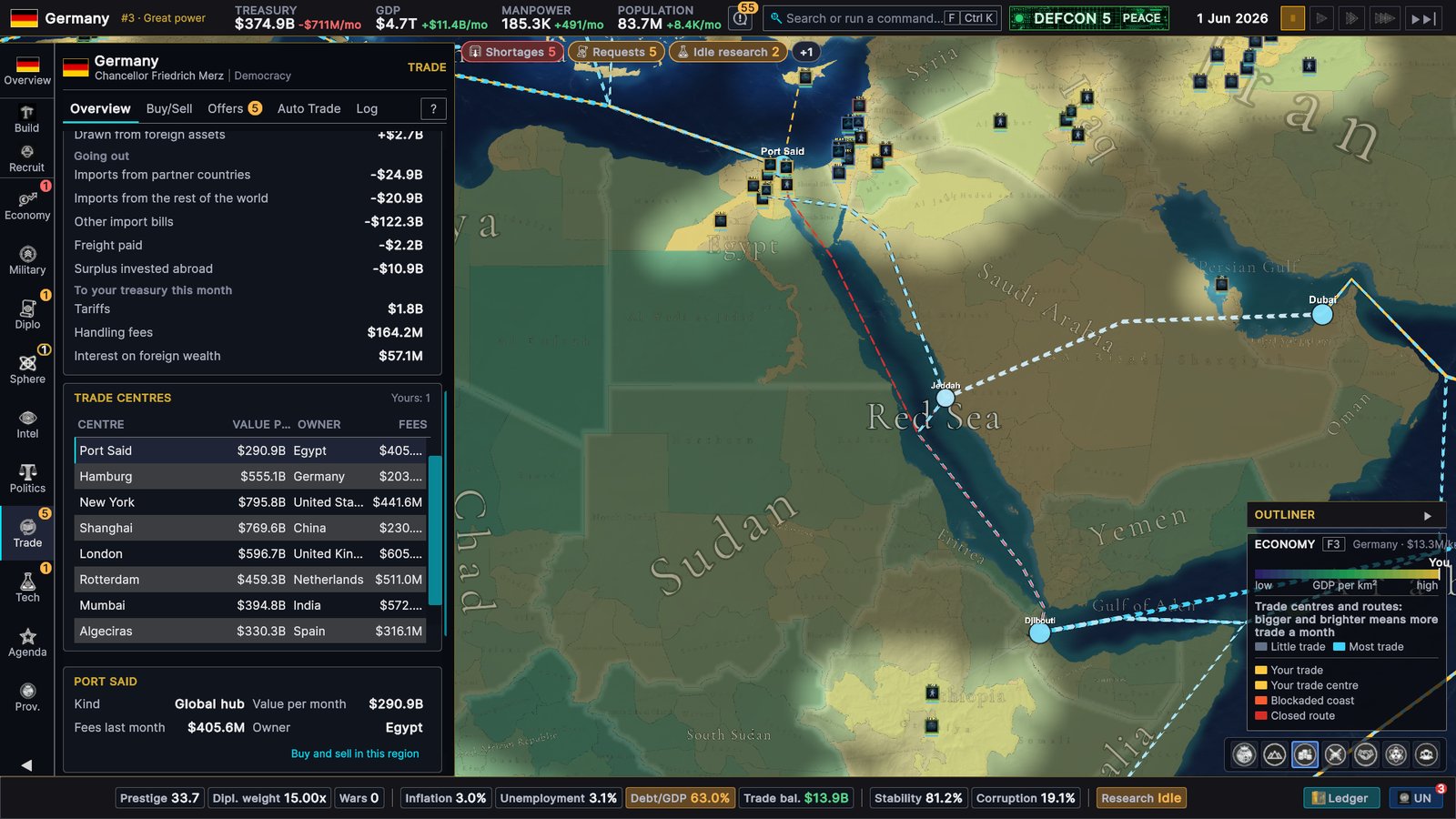
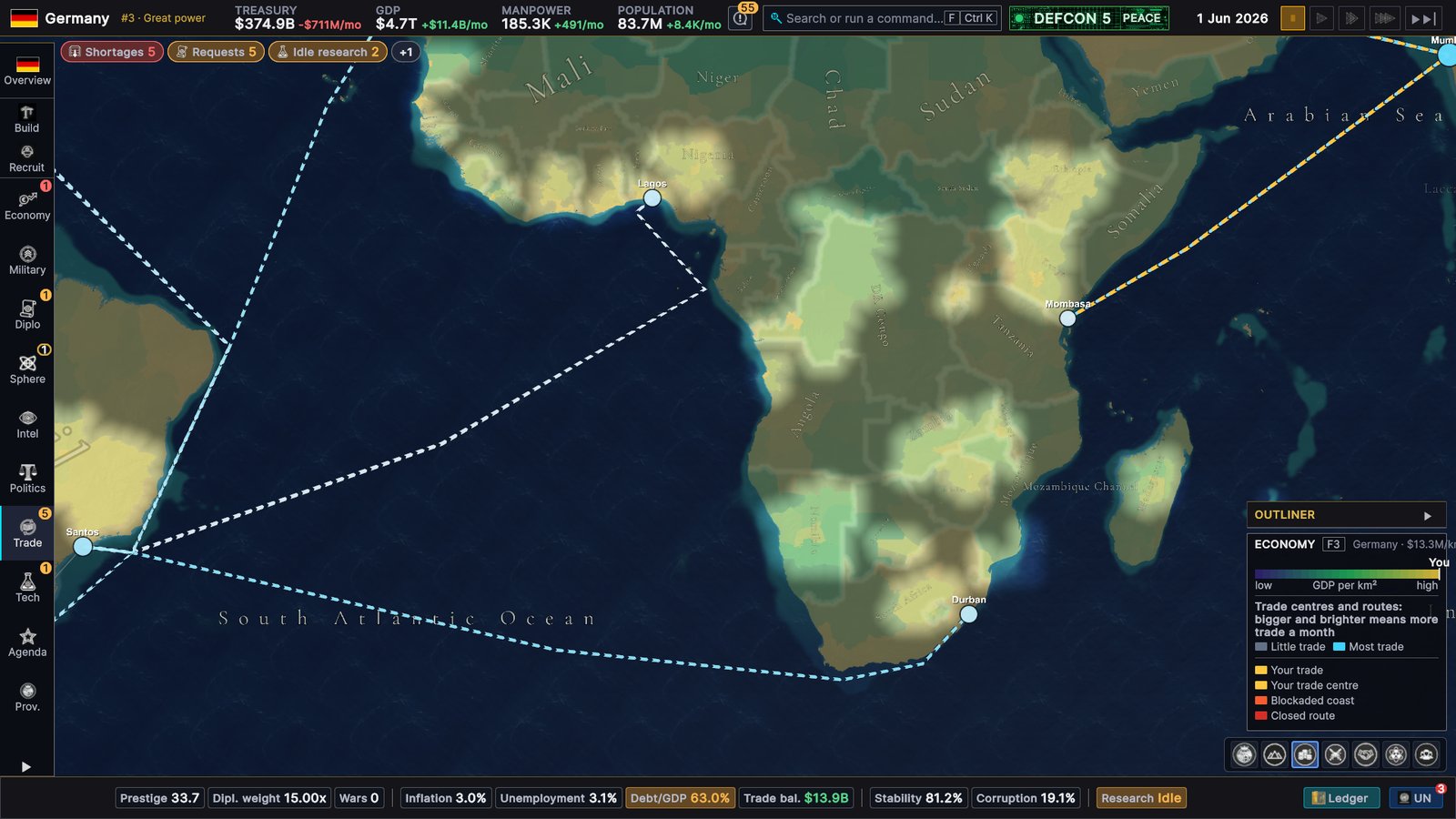
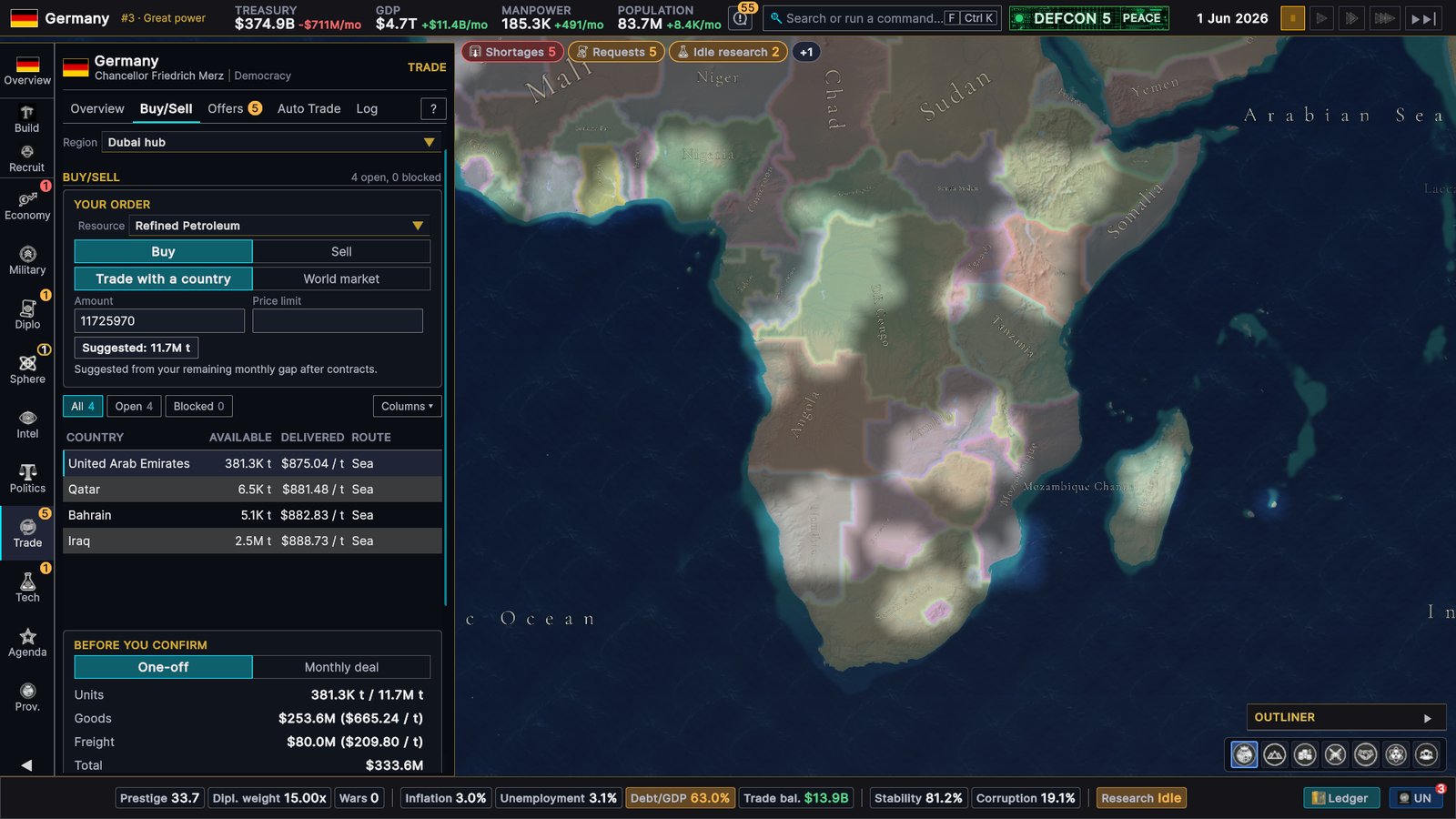
The long way costs money. Refined petroleum from the Gulf, delivered to Germany, rose from $842 to $875 a tonne within a month, as the freight per tonne went from $161 to $210.
On the other side of the world, the South China Sea crisis closed Malacca and the Taiwan Strait in our Australian game. The red dashed lanes are the closed ones; Australia’s own trade, in gold, goes round to the south.
Crises aren’t the only thing that can block trade:
- War stops trade. Countries at war don’t trade with each other, and sanctions cut a pair’s trade.
- An embargo leaves only a trickle of private trade: 10% of what it was.
- A blockaded coast — marked with a red ring on the map — loses half of its sea trade.
- Poor access costs extra. Where access is poor, world-market prices carry a premium of up to 50%; below 5% access, the market won’t sell to you at all.
The AI reads all of this too: it picks its suppliers by delivered cost, so a closed strait reshapes the whole world’s trade, not just yours.
Spheres of influence
The second big part of this update is the sphere of influence — and it starts with the question of who leads.
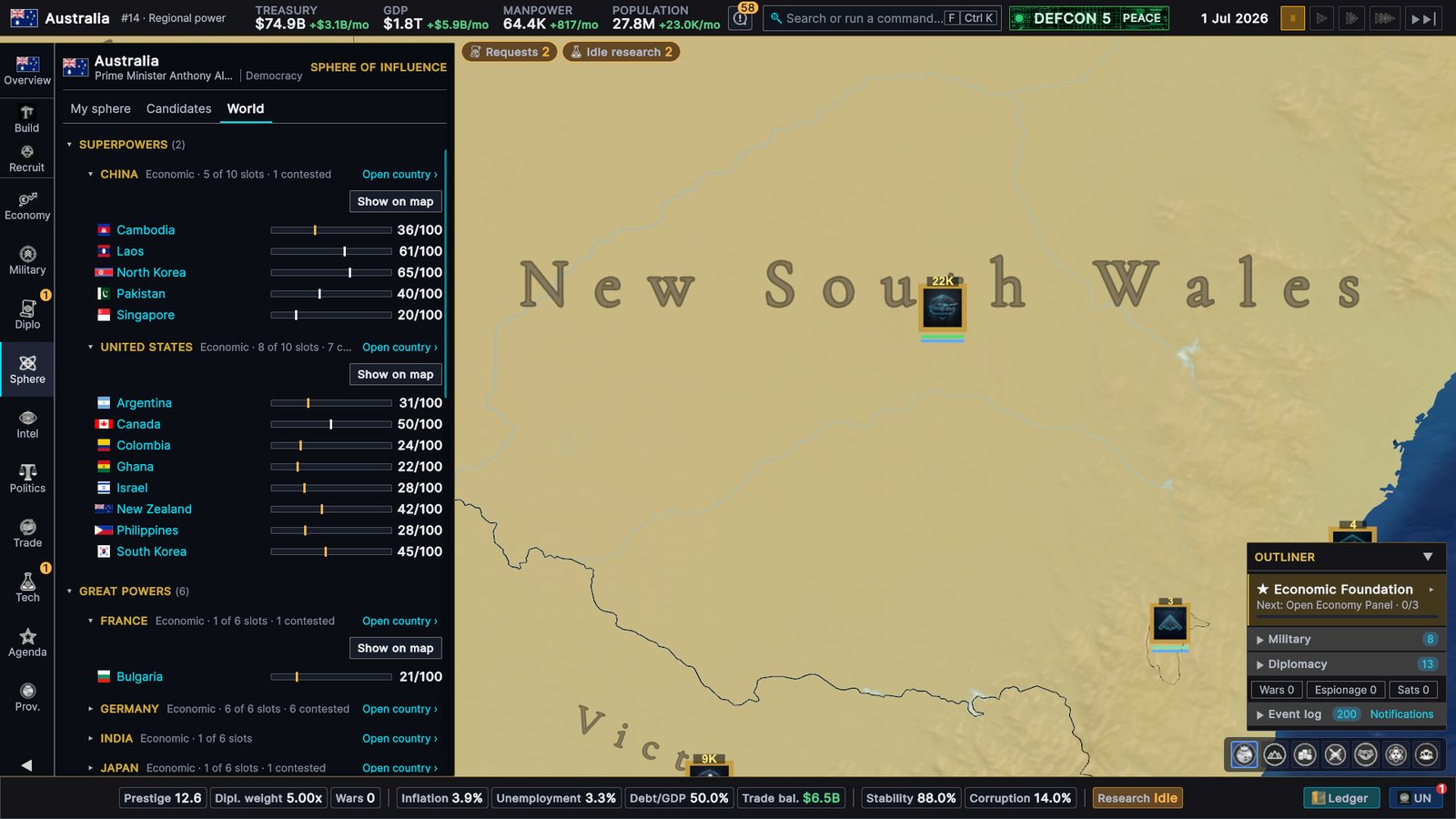
We rebuilt spheres from scratch. Before, a sphere was something the AI managed for itself; it could pull a human player in without asking, and you couldn’t see how it worked. Now spheres are led by ranked powers, and no country joins a sphere unless it agrees to.
Who leads
The strongest countries hold a power tier, and yours is shown in the top bar next to your world rank.
| Tier | Members | Influence projects |
|---|---|---|
| Superpower (at most two) | 10 | 3 |
| Great Power | 6 | 2 |
| Regional Power (up to two per region) | 3 | 1 |
Superpowers and Great Powers can reach the whole world; Regional Powers reach their own region and its neighbours. A power that slips down a tier keeps its sphere for a 12-month grace period.
Choosing a charter
Founding a sphere means choosing what it is for — and every member sees that charter before it accepts.
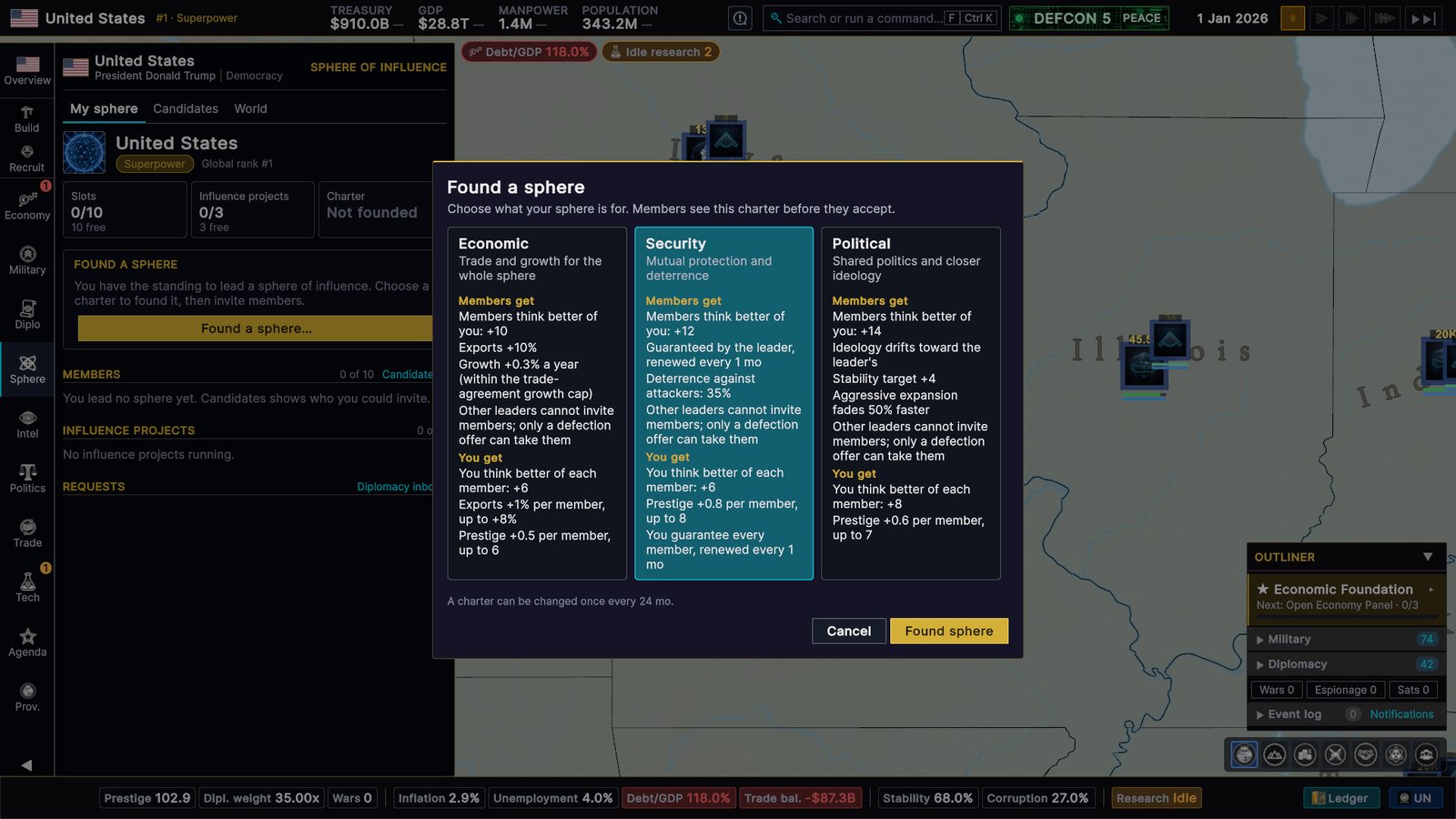
- Economic: trade and growth for the whole sphere. Members get +10% exports and +0.3% growth a year; the leader gets +1% exports per member, up to +8%.
- Security: mutual protection. The leader guarantees every member, and the sphere deters attackers.
- Political: shared politics. Members’ ideology drifts toward the leader’s, their stability target rises by 4, and their aggressive expansion fades 50% faster.
Under every charter, other leaders can’t simply invite your members away — only a defection offer can take them. And you can change the charter once every two years, at an opinion cost with your members.
Influence: earning the right to ask
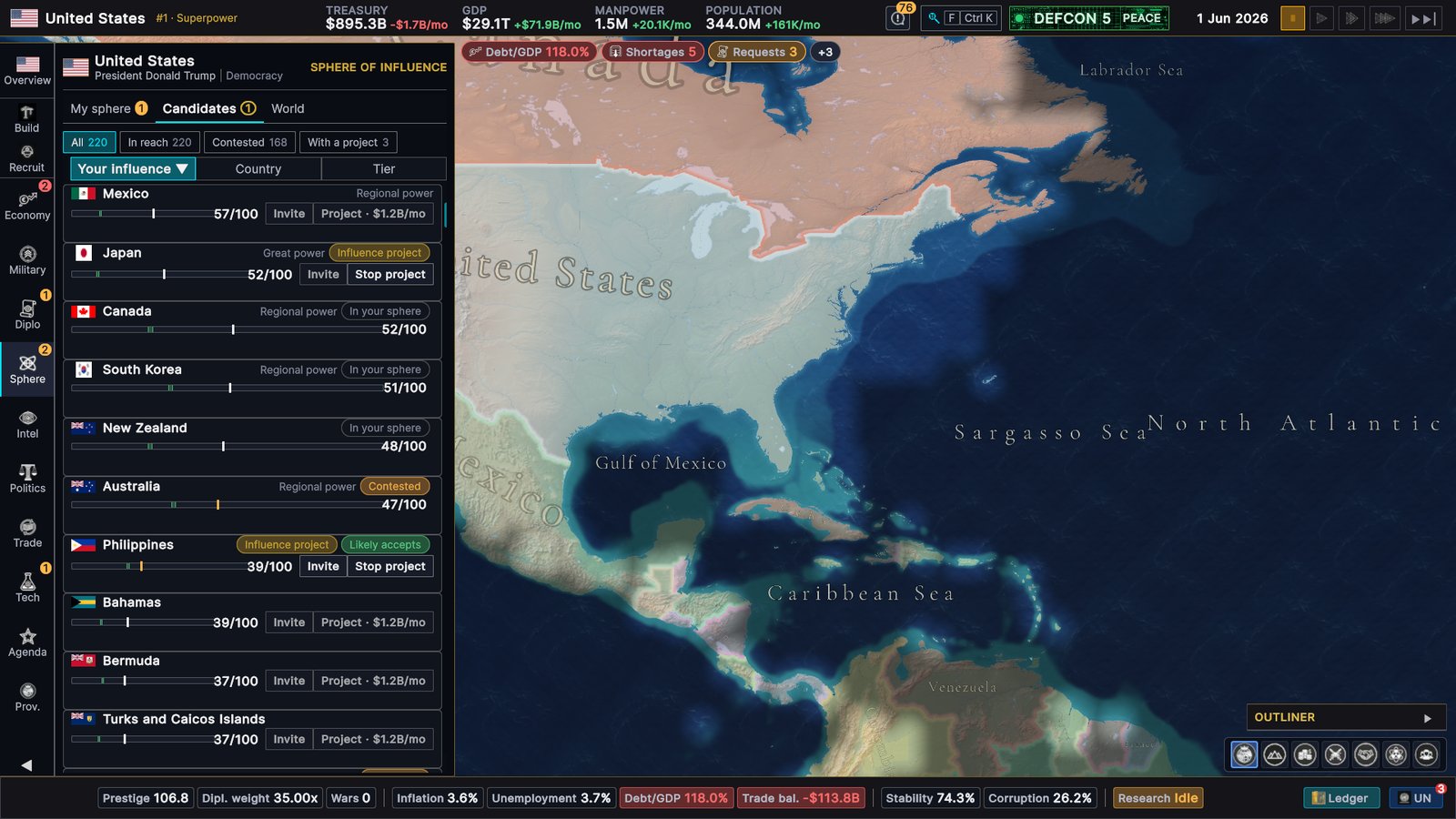
Before you can invite a country, you need influence over it: a score from 0 to 100, built from sixteen sources — geography and region, shared ethnicity, religion and ideology, relations, trade, embassies, debt, aid, guarantees, alliances, envoys and paid influence projects. Trade is one of them, so the deals you sign also pull countries toward you. Influence fades by 5% a month unless you keep it up.
Consent, not conquest
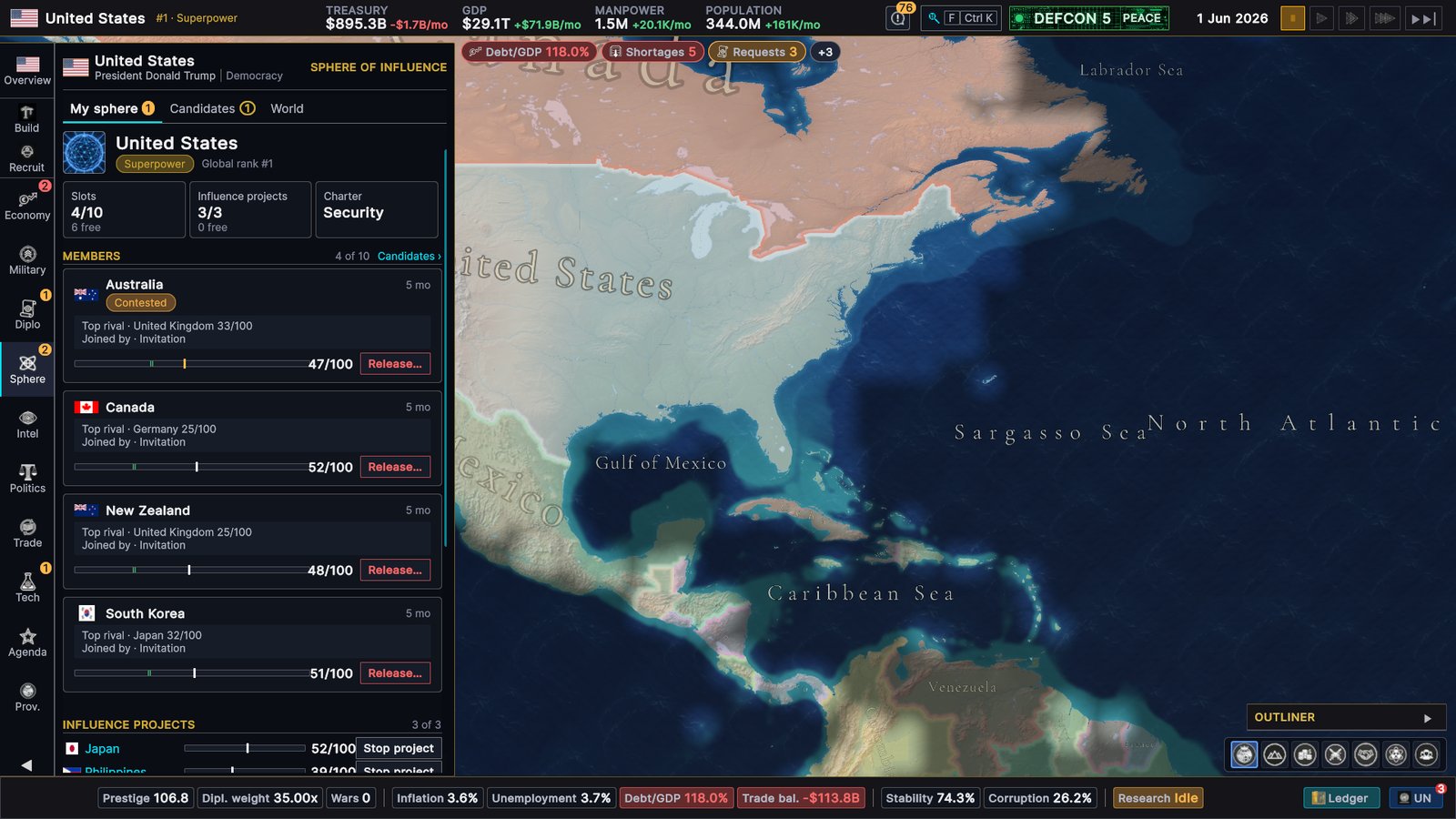
- Invitations open once you hold 35 influence over a country. The country decides.
- A human player is never joined automatically. Invitations arrive in your inbox, a few at a time, and expire after 60 days if you don’t answer.
- Small countries can ask to join. A country can petition a leader that holds at least 20 influence over it.
- Leaving has a price. A member can leave, but it can’t rejoin for a year.
Rivals and defection
Spheres don’t stay settled. A rival power that builds at least 45 influence over one of your members, and holds a lead of 15 points over you for six months, can make it a defection offer. The World tab shows every sphere on the planet, who leads it, how many members it has and how firmly it holds them.
Built to grow
Spheres are the first layer of something bigger: a world where it matters who answers to whom. They give the game ranked powers, influence that can be measured, and membership based on consent. That is the groundwork we want to build overlords and vassals and proxy relationships on, in later updates.
The price of peace
Ending a war used to be a single list of demands. Now it happens on the map.
Open the Peace view from the war dock and click the occupied provinces you want. Every demand — a province, war reparations, humiliation, a change of regime — has a cost, paid from a peace budget that grows with your war score. And the other side answers live: Will accept or Will refuse, with the reason.
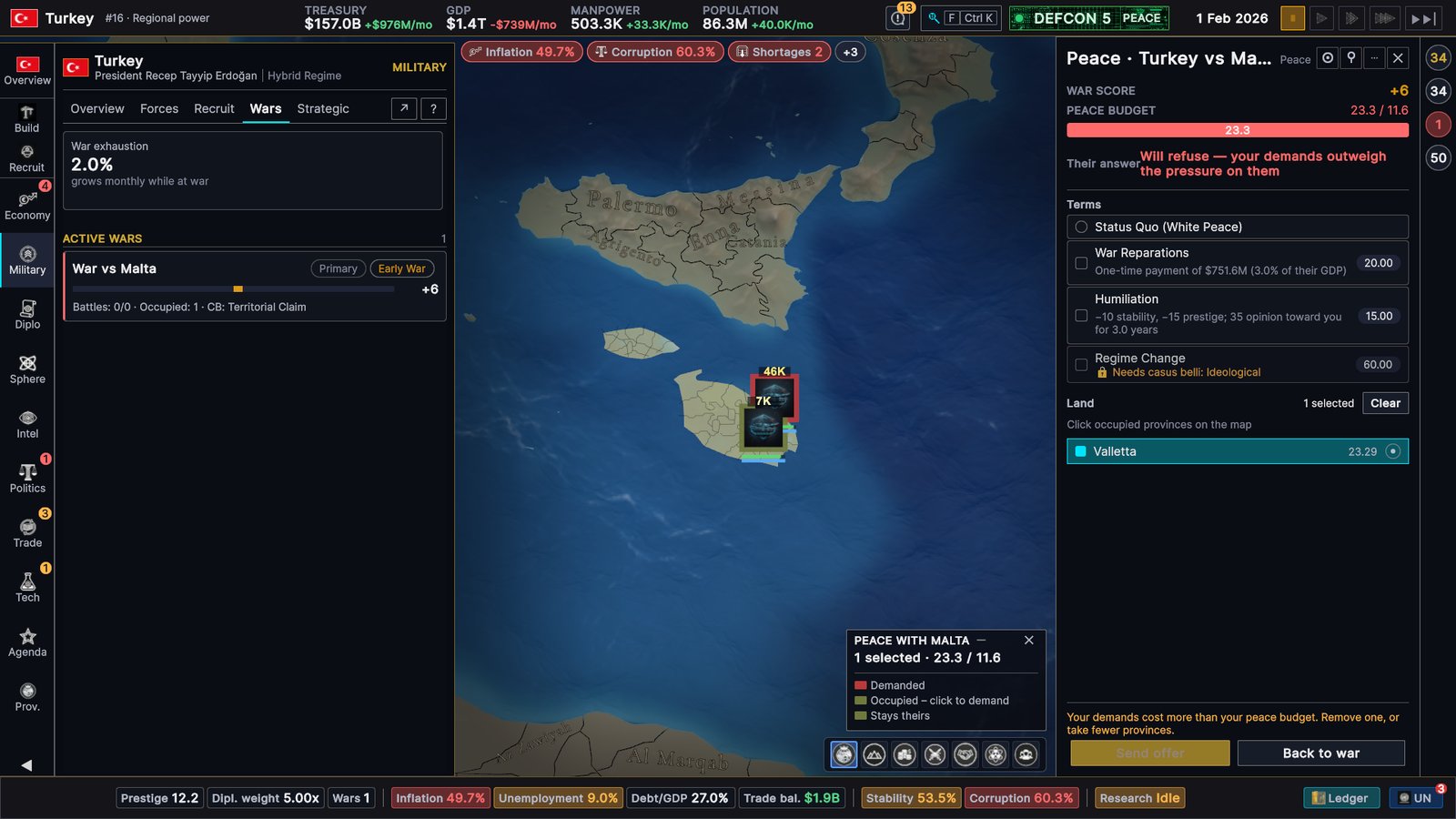
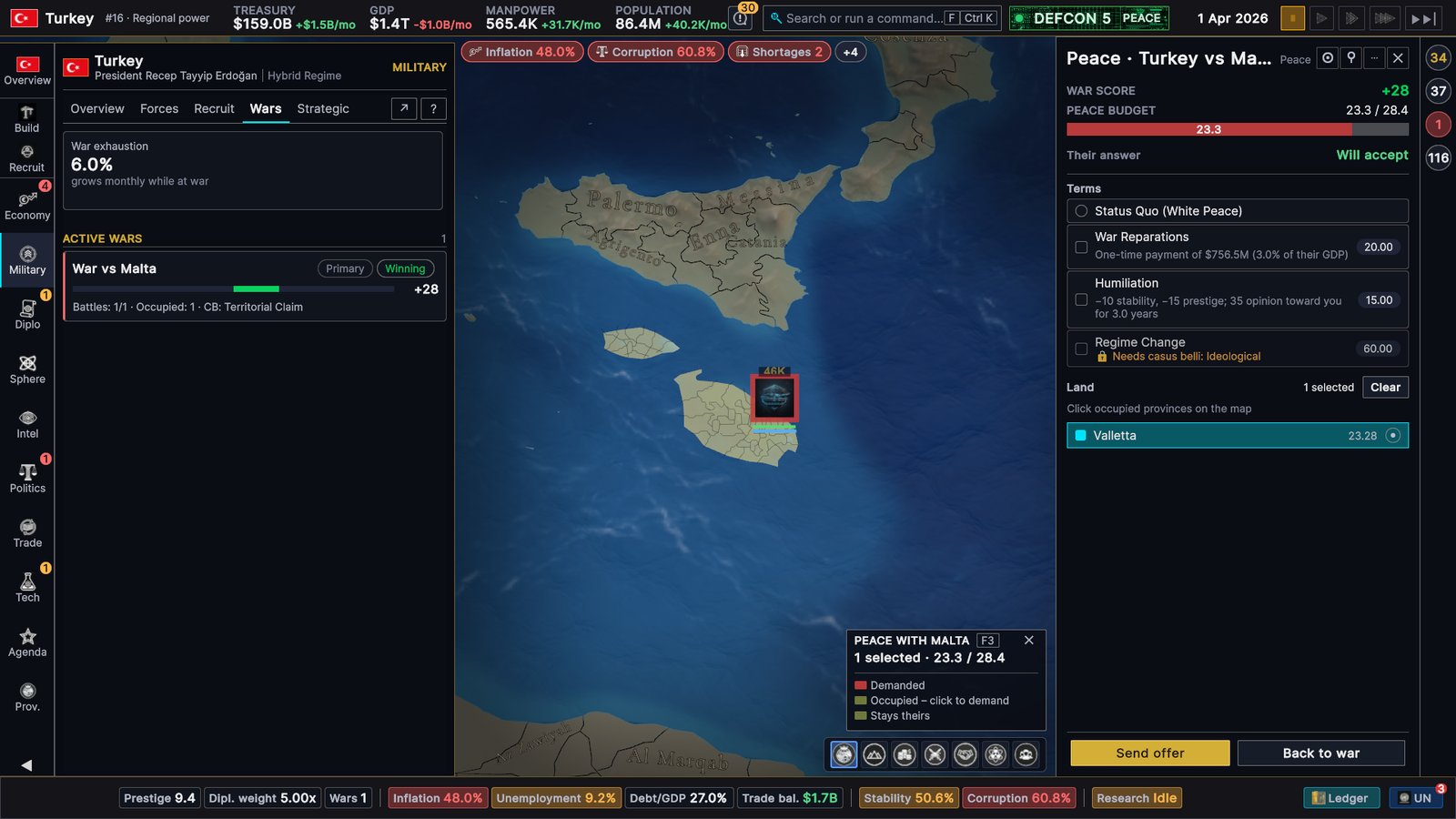
- The AI decides for itself. Before, a peace offer from a human player was judged only by the sender’s own estimate, which never refused a white peace. Now the AI weighs every offer in the simulation, so a losing player can no longer walk away with a white peace on demand.
- Regime change has teeth. With an ideological casus belli, a regime change installs a government aligned with the winner: the loser takes a 10-point stability hit, and its new government starts with a strong opinion of the winner (+25) that fades over two years.
- Picking provinces on the map was one of the requests from our Discord. Thank you for it.
Corruption you can fight
Corruption used to stay frozen at its starting value — one of your reports. Now it moves: every month, corruption drifts toward a target set by your laws, doctrines, stability, inflation and war exhaustion. A free press lowers that target by 4; a state-controlled press raises it by 4.
Corruption also costs you more now. Above 55, it drags your stability target down (by up to 20 points), and above 20 it leaks tax revenue (up to a quarter of it).
To fight back, Politics › Decisions gets an anti-corruption campaign: it cuts your corruption target by 8 for two years — a quarter of that for good — for 0.1% of your GDP and 3 points of stability. You can launch it once every three years, and the AI uses it too.
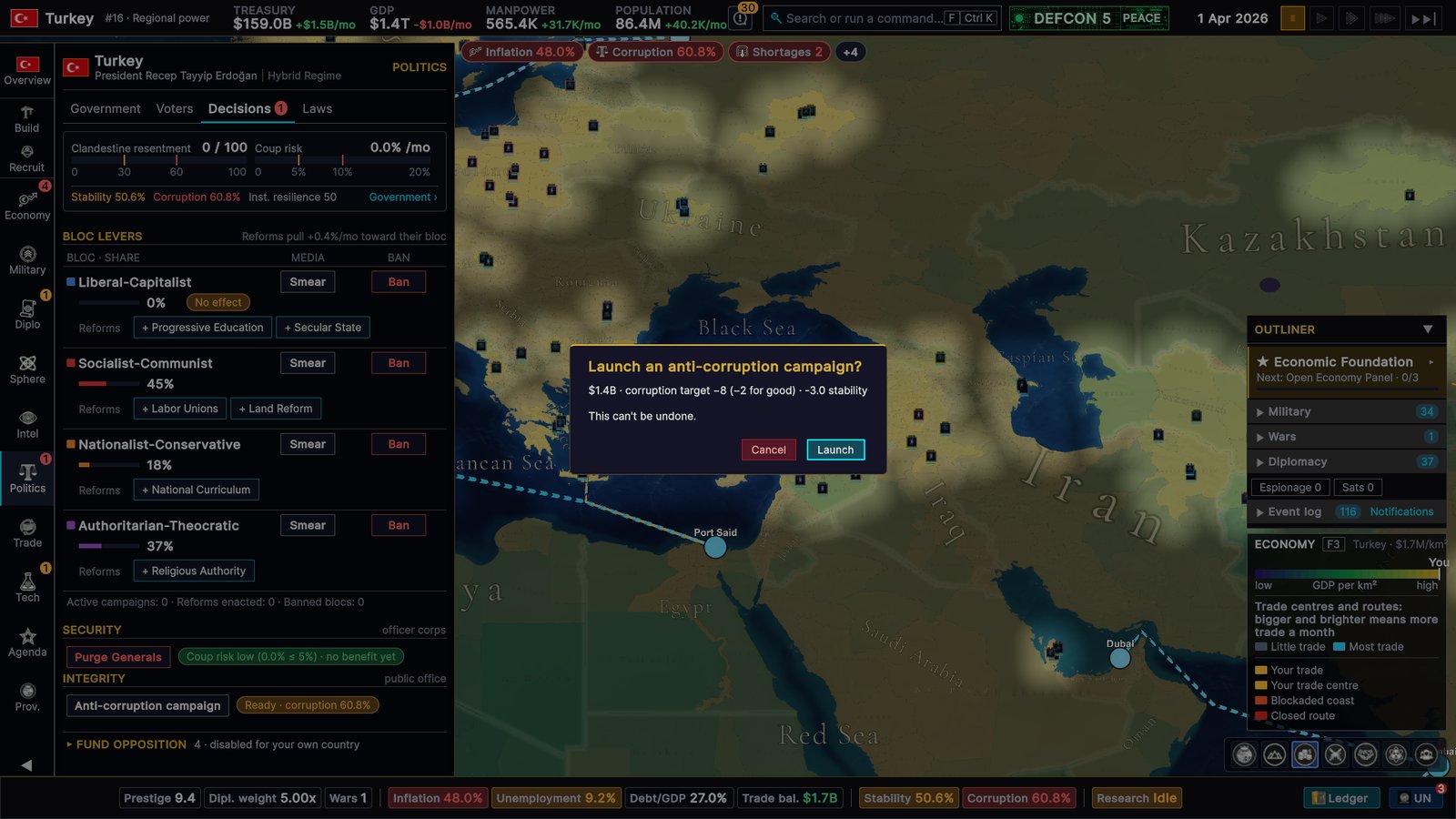
The stability and corruption indicators now name what drags them down most, and take you to the control that fixes it. And national goals that depend on stability or corruption, such as the Anti-Corruption Drive, can now be completed.
Missiles: aim once, fire a salvo
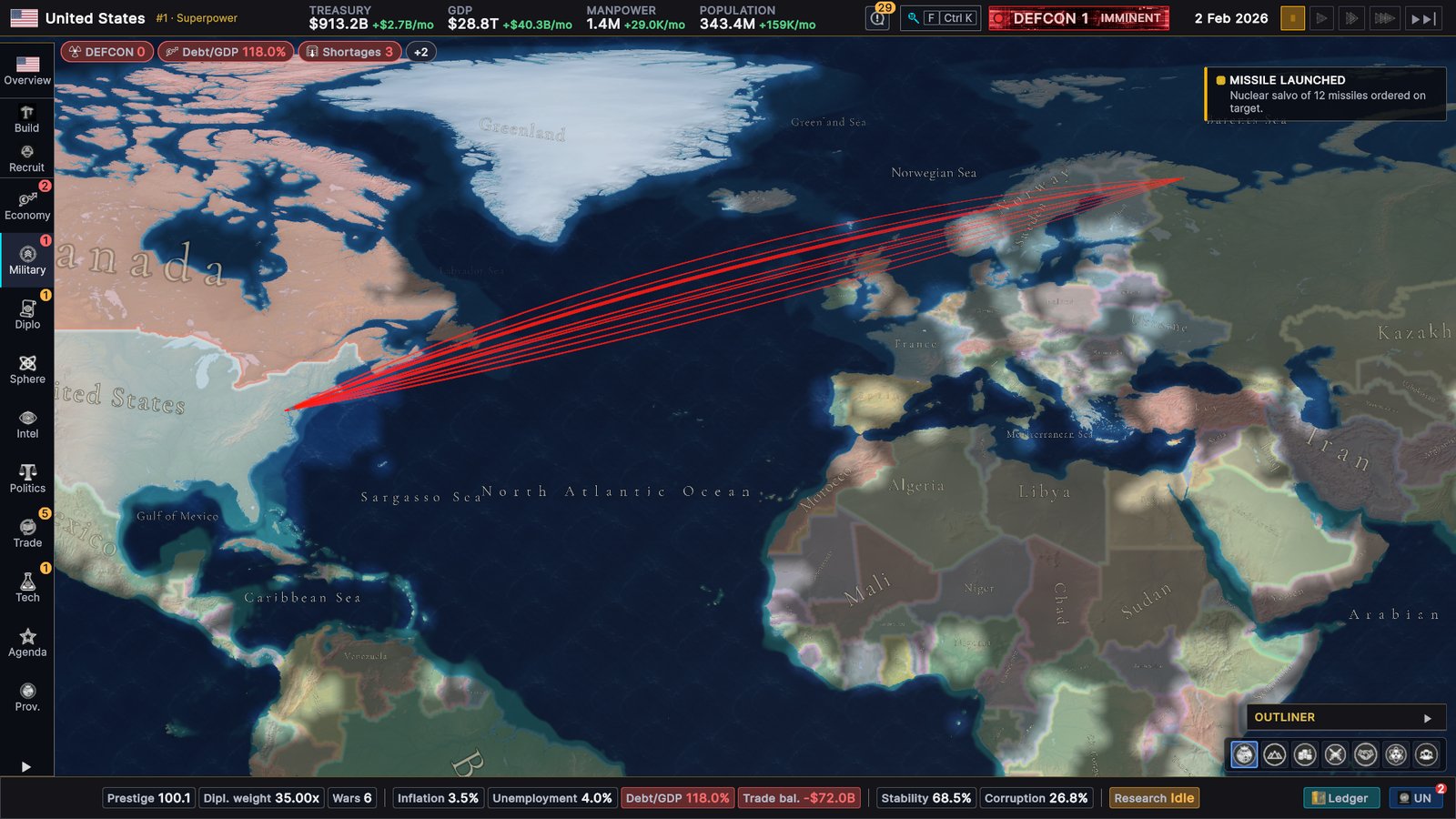
You no longer launch missiles one click at a time. Pick a target and choose the salvo size — one, a few, or everything you can launch.
To show it, we put the United States at war with Russia in a test game and aimed a salvo at the Northern Fleet’s base at Murmansk.
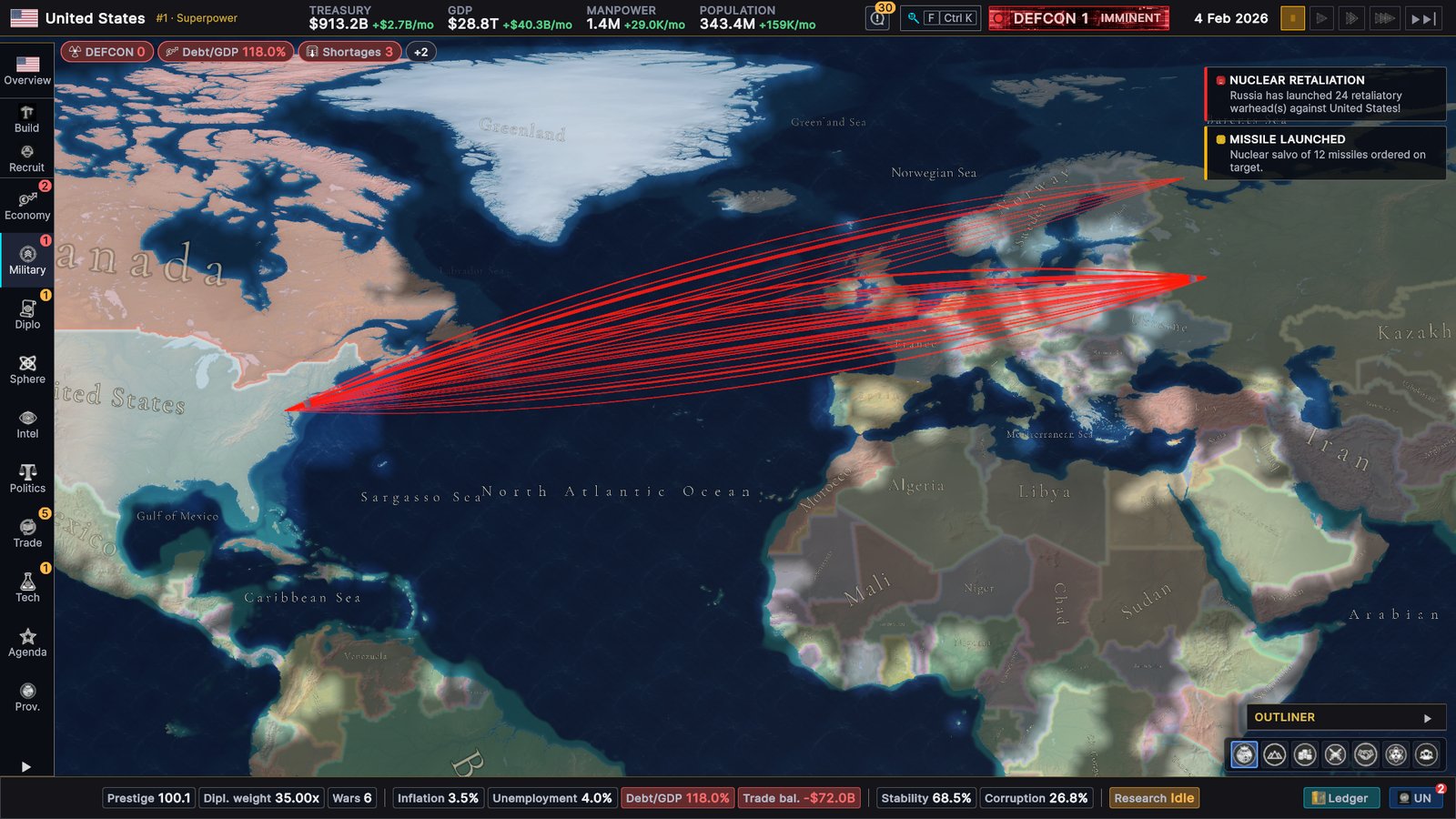
- Conventional and nuclear salvo sizes are kept apart, so a conventional barrage never carries over into a nuclear strike.
- A nuclear salvo from “any silo” fires only from silos that can reach the target, each with its own flight time — and you’re told when only part of the salvo can make it. The AI follows the same rules.
- Satellite launch facilities now support three satellites each, instead of one.
- Every war keeps a record of its losses for each side — including ships and aircraft — and every end screen shows your campaign record.
Multiplayer
Everything above works in multiplayer, exactly as in single player. Alongside it, multiplayer got another hardening pass:
- A resync now reaches every player at once, and the host waits until everyone has applied it before the game goes on.
- A player who rejoins stays in step with the host from the first day back.
- We found and fixed around 30 places where two computers could have resolved the same moment in a different order — battle fronts, naval and bombing losses, AI fleets and armies, coalition ties and more.
- The lobby no longer blocks a game when a mod’s translations differ between players; it just tells you.
For modders
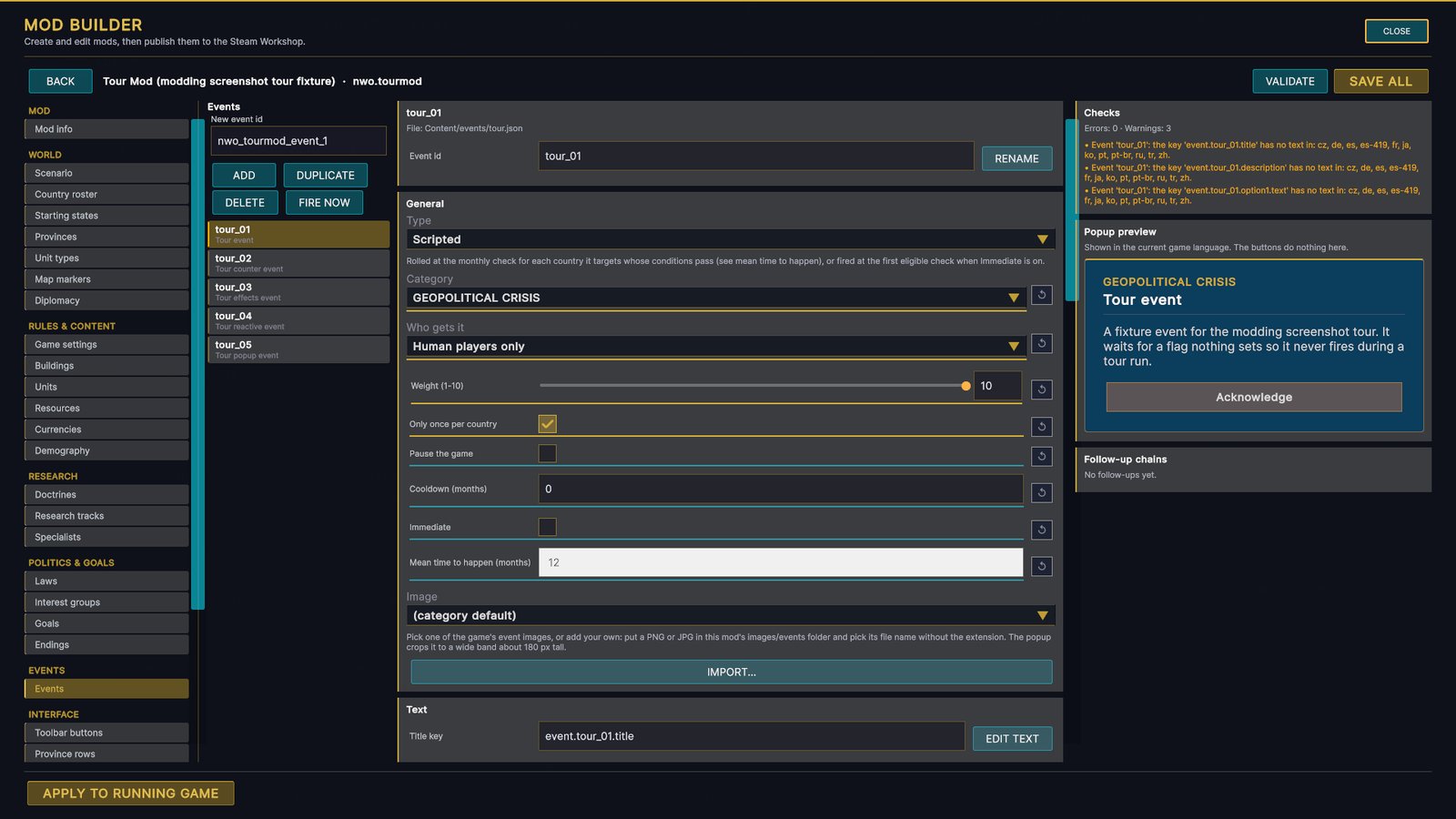
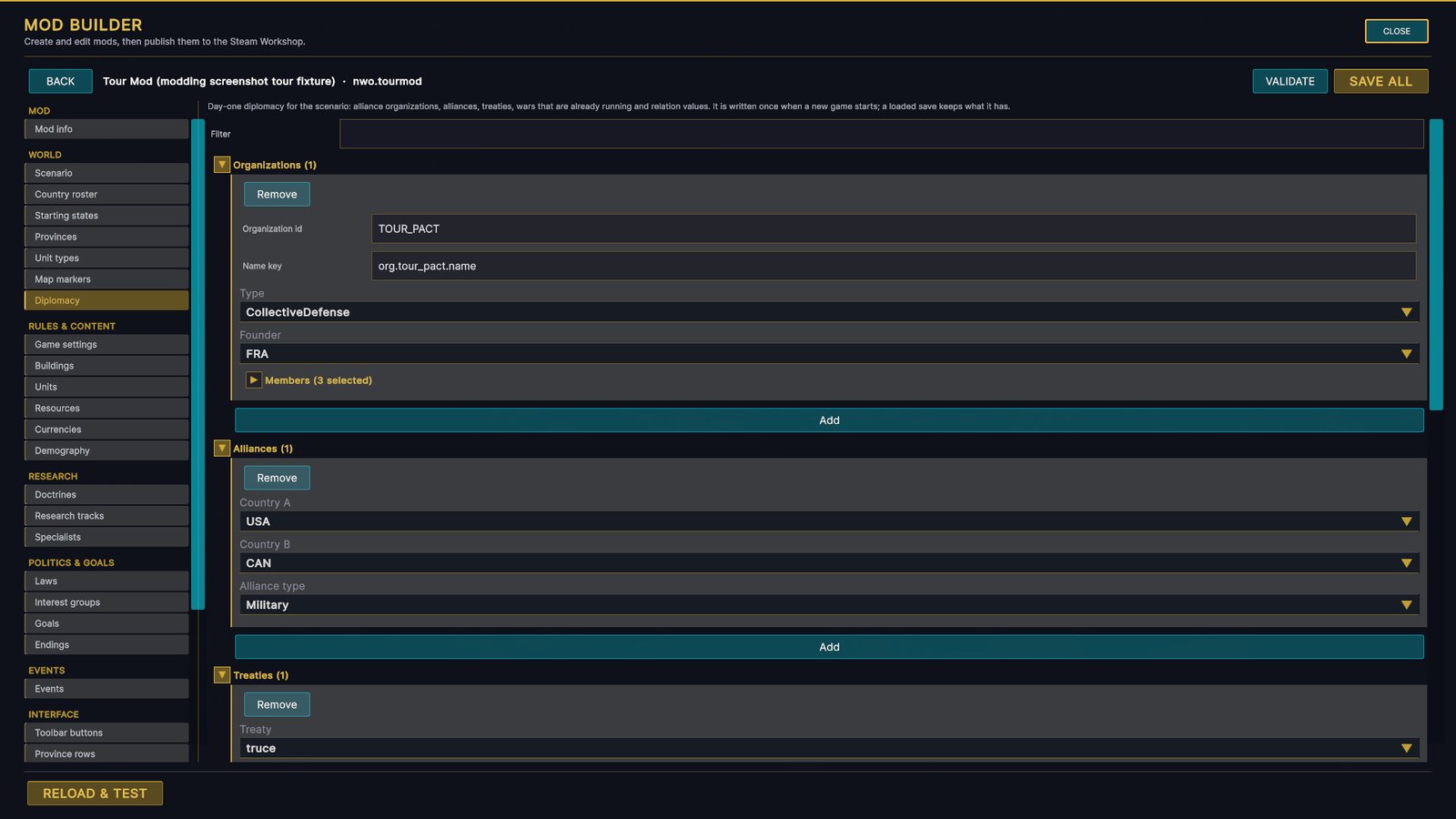
The Mod Builder got its biggest update yet. The screenshots below show our own test mod.
- Edit your mod while you play it. When you play single player with a mod of your own, the Mod Builder opens from the pause menu. Apply to running game reloads your events, texts, scripts and many game settings without restarting, and Fire now triggers any event on the spot.
- A new, grouped menu — Mod, World, Rules & content, Research, Politics & goals, Events, Interface, Text, Publish — with tooltips that explain where each setting is used.
- Scenarios can start mid-story: with alliances, organisations, treaties and wars already running on day one, and with their own leaders.
- New editors: interface themes and layout, unit map markers, endings, a data painter for province data, a goal graph with prerequisites and mutually exclusive goals, research tracks, laws and interest groups, and event pictures.
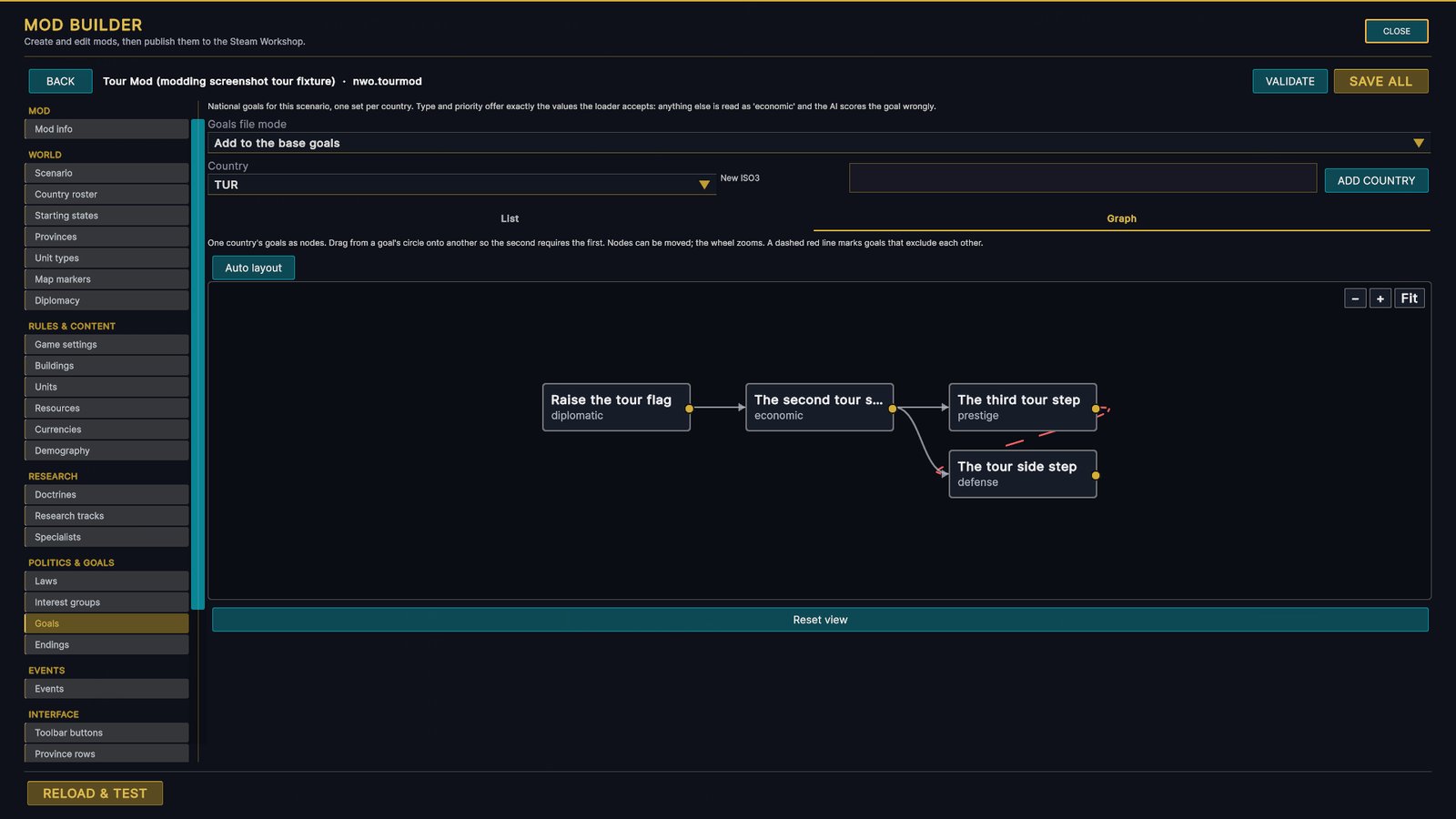
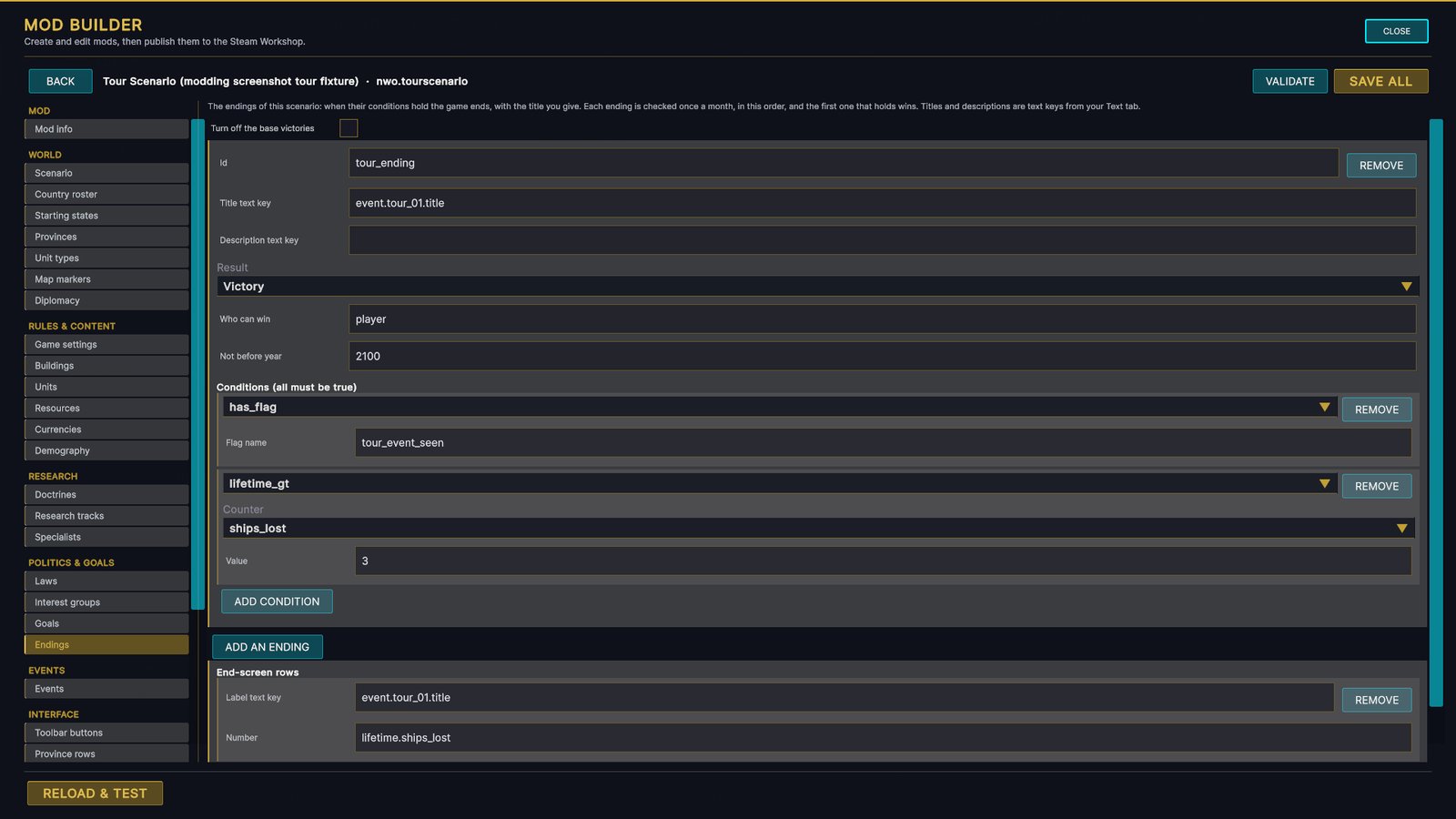
- Events can do much more: declare war, sign peace and truces, form alliances, target every country, keep variables, run covert operations, change militaries and create units. Every reactive trigger now fires.
- Scripts can read the world, set and clear flags and show translated pop-ups, and mods are checked when they load.
And many more changes
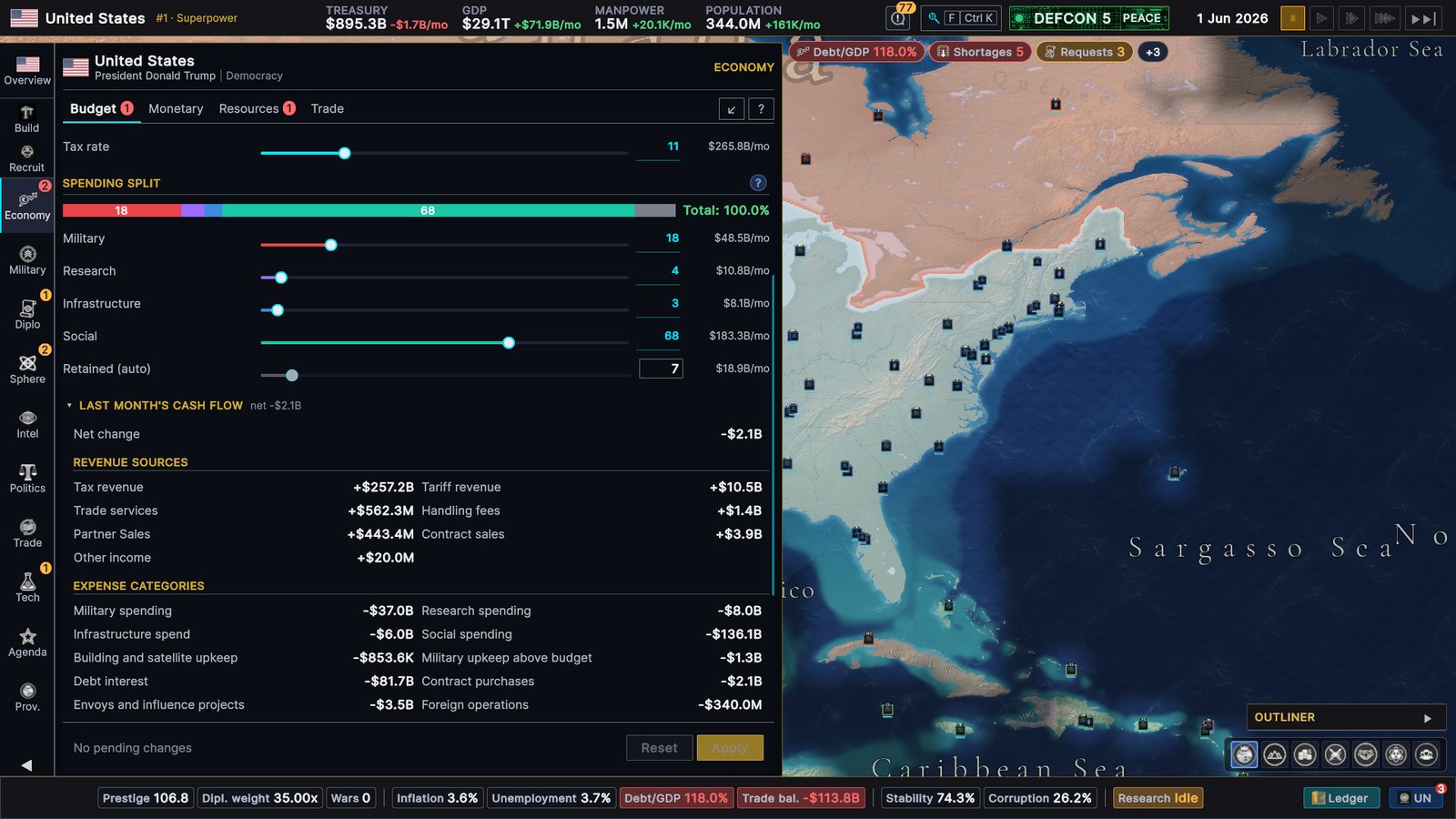
- Budget, GDP and inflation tooltips are now built from the same ledger as the simulation, so the numbers add up.
- Event pop-ups no longer cover your panels, and long options wrap.
- Global events no longer repeat events meant to fire once.
- A recruit order that fails no longer takes your money, manpower or resources.
- Missiles in flight survive a save and load — even when their silo was captured mid-flight.
- The map no longer starts black outside your own country on day one.
- Unit markers no longer leak memory month after month.
- A hover tooltip could crash the game while loading a save or returning to the menu. Fixed.
- Every new line of text — over 2,600 of them — is in all 13 languages.
- Your saves carry over: games from the current version load in the update.
What’s next
We’re still in Early Access, and your feedback decides what comes next — much of this update started with it. Our development roadmap is public: see what we’re working on at our roadmap page.
Thank you
Thank you for every review, bug report, screenshot and long message. If you’re enjoying the game, a Steam review helps a small team like ours more than you know.
See you on the world stage.
— Ozan Kanık, founder, Dorlion Interactive